Pages

Showing posts with label berries. Show all posts

Saturday, July 23, 2016

Blueberry picking!

We are so fortunate to have a no-spray (nearly organic) u-pick blueberry farm nearby!  It's an annual family outing and adventure for us to go picking, usually not just on one day but many throughout the late July to August. We love to have our freezer stocked with frozen blueberries for winter smoothies and baking, as well as dried for handfuls added to trailmixes, granolas - or, our latest favourite way to preserve fruit, as fruit leather!  Here is a quick oven or dehydrator method for making blueberry fruit leather.

Blueberry Fruit Leather - easy oven or dehydrator method

You will need:
  • 1 lb fresh or frozen blueberries (or other fruit - apricots, cherries, peaches, etc)
  • 1 Tbsp lemon juice
  • 1 Tbsp honey (optional)
Method:
 
1) Preheat oven to 170F (or prepare dehydrator sheets).
2) Prepare baking sheet (or dehydrator sheet) with parchment. 
3) Place ingredients in blender and blend until smooth.  Add a little water as necessary to help blend.
4) Pour blended juice onto prepared baking sheet or dehydrator screen.
5) Spread out evening, but leave a margin around the edges of the pan/sheet.
6) Bake 6-7 hours in oven (aprox the same in dehydrator) until juice is not sticky anymore.
7) Cut into sheets or strips, roll up in the parchment paper into snack sized portions.
8) Store in glass mason jars.  Enjoy!


Friday, July 15, 2016

Local Superfood Spotlight: Black Raspberries

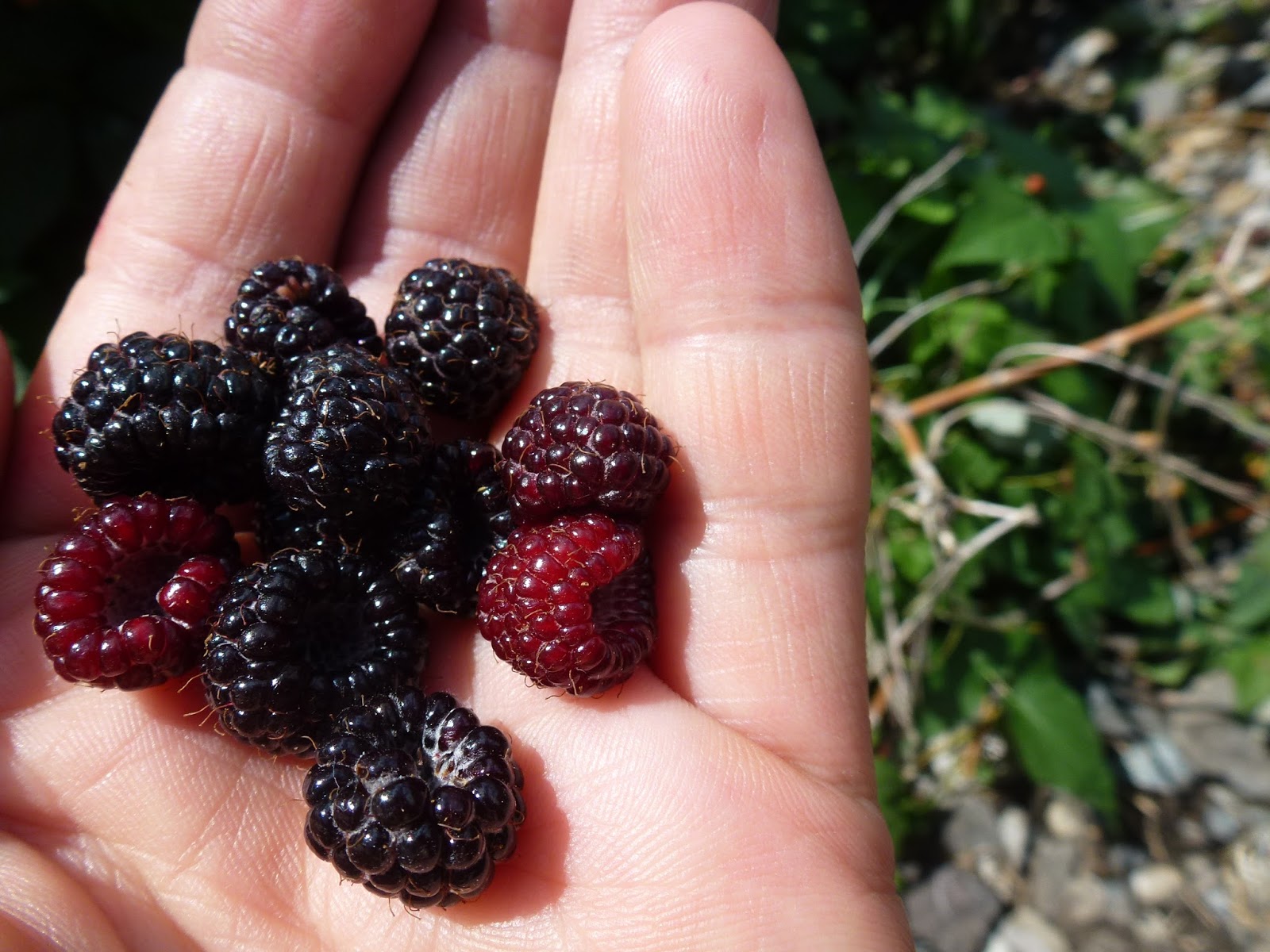
Move over goji and acai berry!  We have wild black raspberries here, and they are free, abundant, and packed with nutrition.  By now it's mid July, and it's proving to be a very bountiful berry harvest this year!  Currently, the black raspberries are in full production, growing wild along many ditches, park trails and roadways.  They line our back fenceline in huge bushes - a wild weedy patch, yet abundant in fruit.  We have have the pleasure of going out each morning for the past week to harvest huge bowls of berries for breakfast, with more than enough to stock up the freezer as well. 

Tips for harvesting:
Black raspberry (Rubus occidentalis) is related to the red raspberry (Rubus ideus), is native to North America and grows wild in many locations, including urban areas like parks, trails, river banks, ditches, and other abandoned lands.  The berries are ripe when deep dark red-black coloured, and should come off easily when plucked from the stem.  The stems and stalks are prickly with little thorns, so some careful picking is necessary in order not to get scratched.  But the slow careful picking is well worth it, as these black raspberries are amazing in luscious, rich flavour.  Here is an interesting site to tell you about the differences between red and black raspberries, as well as how to differentiate between a black raspberry and a blackberry.

Why are black raspberries a superfood?
Black raspberries (as well as blackberries and red raspberries) are extremely high in antioxidants, meaning they offer multiple health benefits including cancer-fighting properties.  The black raspberries specifically contain high levels of anthocyanins, which give them their rich, dark color. Anthocyanins work as antioxidants that help fight free radical damage in the body.  

How to use:
Eat ripe berries warm off the plant!  Feed to your kids!  Get them to help you pick.  Or freeze, dry or cook into jelly, jam, or syrup.  The black raspberry leaves can also be used for herbal tea, either hot or iced.  Steep a handful of fresh leaves (or 1-2 Tbsp dried) in 4 cups water that has just boiled for at least 10 minutes.  Sweeten with honey or maple syrup, or add fresh mint leaves to the tea blend for additional flavour.  All species of raspberry are medicinal, usually red or black raspberry is most common for women's tea (helps to regulate hormones, helps to tone uterus before labour and birthing, rich in minerals and calcium).


Wednesday, June 29, 2016

Local Superfood Spotlight: Mulberries

End of June, and the mulberries are ripe.  It seems there was a nice trend to plant mulberries and service berries in public areas around our town as edible landscaping some years ago, and we are now reaping the benefits.  There seem to be ripe mulberry or service berry trees on nearly every street, often the service berries are lining the boulevard all the way along.

Tips for harvesting:
The mulberry trees are generally easy to spot - distinctive lobed leaves, and the tell-tale signs of a blue-stained sidewalk or roadway below.   These trees can be quite tall, so picking by ladder might be in order to get the most benefit.  It's often easiest to gather the berries that have fallen to the ground, or climb the lower tree limbs and shake the branches to drop berries below onto a waiting ground sheet.

Why are mulberries a superfood?
Mulberries are one of our amazing nutrient-dense local superfoods.  They are full of antioxidants, high levels of vitamins (A, C, E, K), iron, protein and fibre, and also help boost the immune system. They have been found to regulate the blood sugar, and also help cleanse the blood and detoxify the body by stimulating the liver.  They are all around wonderful, tasty, and easily harvestable locally (for free!) if you take a bit of time to find them.

How to use:
We love freezing mulberries for winter smoothies, but also eat them fresh in our granola, or by the handful as we pick them.  They make a wonderful pie, jam and jelly as well.  Mulberries, when dried, are perfect for trailmixes or eating as a snack on the go.


Sunday, July 26, 2015

Gratitude Sunday


We are grateful for so many things.  Here is what comes to mind from this past week:

~ abundant berry harvest with friends - and delicious chokecherry juice they brought us as a sample of the harvest (upon their suggestion we're going to add the juice into our morning smoothies)
 ~ fresh flowers, flowers, flowers - all the beautiful bouquets that are being picked and placed in all rooms of our house and throughout our B&B

~ eating our first garden tomatoes and zucchinis, plus so many braising greens, and the delicious black seeded simpson lettuce that just keeps on producing (I could eat like this every day)

~ wool diaper covers made by our friend Amaryah at Sew Oiseau - I am totally sold on using wool diaper covers for the cloth diapering experience this time around (even in summer she swears by them as best breathable covers for babies on hot days, next to wearing nothing of course)

~ all the busy busy bees in the garden (more on this soon) - the variety of bees I see each day: mason bees, bumble bees, sweat bees, honey bees in the bergamot, oregano, echinacea, yarrow, rudbeckia, clover, calendula around our yard - wow - it's a busy time out there right now


Monday, July 06, 2015

Gratitude Sunday


We are grateful for so many things.  Here is what comes to mind from this past week:

~ peas and more peas as we near the final harvest (and purple ones that we love to grow each year!)

~ a "cupcake and flower stand" in our front yard that our young entrepreneurial daughter decided to set up  with her friends on the weekend (and the friends and neighbours who dropped by to support our young entrepreneurs)

~ one dozen delicious Seed of Life bars that I was happy to barter in exchange for plants from our garden!  (if you have not tried these amazing high-quality handmade energy bars yet then by all means check them out!  They are now available at the Kitchener market, and various local health food stores - made locally by our friend Theresa)

~ a gifting of organic bokchoy and (my favourite) hakurai turnips from our friend Angie at Fertile Ground CSA - gorgeous produce that we just can't seem to grow here like she does on her farm!

~ a sweet baby in our house that now sleeps for more than two hours at a time!

~ the season of fresh local berries!  red currants, service berries, mulberries, raspberries and blackberries and soon to be ready cherries and blueberries

~ Tulsi (or Sacred/Holy Basil) that we grow in abundance in our herb garden, with it's many health benefits - for gifting to friends, drying for winter tea blends, and making into this refreshing Holy Basil Sipping Vinegar

What are you grateful for this week?


Friday, August 02, 2013

Blueberry picking!

Blueberries!  A mid-summer rite of passage for our family, going berrying with friends at our favourite local organic blueberry farm to pick our fill of delicious berries that will hopefully last us for smoothies and pancakes all winter long.  Walkers Blueberries, near New Hamburg, has been in business for many years and has a strong base of returning customers.   We will certainly be back there next year, if not sooner!


Friday, June 28, 2013

Mulberries and urban fruit foraging

Our mulberry tree is finally producing - we have both a male and female tree in our yard, both planted not by us but by birds dropping seeds.  It's one of the nice surprises we got when we started tending our overgrown part of the yard (former driveway) that was behind our strawbale house addition after the building project was done. The male doesn't produce fruit, but the female tree is loaded with berries this year.  This tree is already high enough that the top branches need to be harvested by ladder, but luckily the low branches droop down and many higher berries fall to the ground when ripe.  There is certainly more than enough for us to gather.

It reminds us of the many forgotten fruit trees, berries and other wild edibles all around our city, left over from old orchards or planted in parks, boulevards or yards.  Just in walking distance right in our own neighbourhood, the service berries lining the boulevard of the next street over are in full swing with delicious berries just low enough to reach when you walk by on the sidewalk; there are several large mulberries in a park nearby; wild grapes and raspberries are growing all along the old railway line; and an old apple orchard with 4 well-producing trees is behind an older factory.  This is not even considering all the fruit trees that may be forgotten in yards where homeowners no longer tend them.  Our cities are full of food, and we could be much more organized in planting, tending and harvesting it.  In many cities there are urban harvesting groups that are banding together to collect these delicious resources - Not Far From the Tree in Toronto is a wonderful example.


Berrying

What a busy time the end of June is!  Lots of garden projects, endless weeding, first herb harvests, and the start of berry season.  June is strawberry season around here; then come currants, mulberries, cherries, raspberries, blueberries all through the later summer months!  We had the first ripe strawberries from our own garden and then knew it was time for the annual early morning berry picking trip to one of our favourite local organic farms where you can pick your own: Organic Oasis.

Then on Saturday we held a sugar-free jam making (no refined sugar) workshop here at Little City Farm and made up a batch of delicious strawberry-honey jam (made with honey and apple cider as sweetener) that looks and tastes as close to fresh berries as you can get with a jam.  Regular sugar jams contain a ratio of 7 cups sugar to 5 cups fruit, and in the end all you taste is the sugar that has overpowered the true fruit and berry flavours.  You really can make perfect jams without refined sugar, using honey, agave, maple syrup, pure fruit juices, stevia or even xylitol.  The texture and colour is slightly different, but using a low sugar pectin like Pumona's the consistency and flavour is just right.  What a treat for winter that will be.  Now it's time for fresh eating, strawberry smoothies, making berry fruit leather, a strawberry pie or two, and of course putting them up in the freezer for the cold months.


Monday, July 09, 2012

Fresh blueberries

This weekend we had our first taste of local organic blueberries!  It's an annual pilgrimage to make our way to Walkers Blueberry Farm near New Hamburg, to pick enough for the winter and eat our delicious fill.  As you can see, on hot day it's wise to go early and then get some rest  under the shady bushes...


Friday, July 06, 2012

Berrying

Wild berries are ripening and abundant everywhere here in the city!  We've been feasting on black raspberries, currants, service berries, and mulberries, and try to keep a few harvest containers in our bike trailer at all times just in case we come across a patch of edible berries along our travels.  It feels so rewarding to wild harvest the berries that are often overlooked and forgotten.  The wild grapes are coming in volume too...and early  tomorrow morning we are going for the annual blueberry picking at a favourite nearby organic blueberry farm.  We love berry season in this house - our hands, faces, knees and shirts become stained with the delicious dark sweet juice, smells of rich jam-making fill the house, many berries go into the freezer for enjoyment over the cold months, and of course handfuls upon handfuls go straight into our mouths still warm from the sun! 

Here's a simple recipe that we created for using both blueberry (or any berries) and rhubarb.  We use the Pumona's pectin (a low sugar pectin) so you can reduce the amount of sweetener and still get a perfect result.   The jam tastes like pure blueberries even though it requires minimal amounts - the rhubarb blends well with the berries and helps to stretch the volume of jam you get.  You can use fresh or frozen berries and rhubarb.


Wild Berry-Rhubarb Jam

4 cups chopped rhubarb (make sure you have some pink stalks so you get a richer colour of jam)
1/2 cup water
2-3 cups blueberries or other berries (mulberries, blackberries, service berries)
1 1/2 Tbsp lemon juice
4 cups sugar
2 tsp calcium water (this comes in powder form with the Pumona's pectin)
4 1/2 tsp Pumona's pectin

1. Bring rhubarb and water to a boil, and simmer 5 minutes or until thickened. 
2. Add berries and sugar, and heat to dissolve sugar. 
3. Blend with a submersible blender until jam has desired consistency.
4. Add calcium water and pectin as directed on Pumona's instructions.
5. Bring jam to a hard boil for at least 1 minute.
6. Ladle hot jam into hot, clean and sterilized mason jars. 
7. Follow regular jam processing instructions (add hot lids and rings, process 5 minutes once canner returns to a rolling boil).

Makes 7 1/2-8 cups jam.