Pages

Showing posts with label local harvest. Show all posts

Friday, July 15, 2016

Local Superfood Spotlight: Black Raspberries

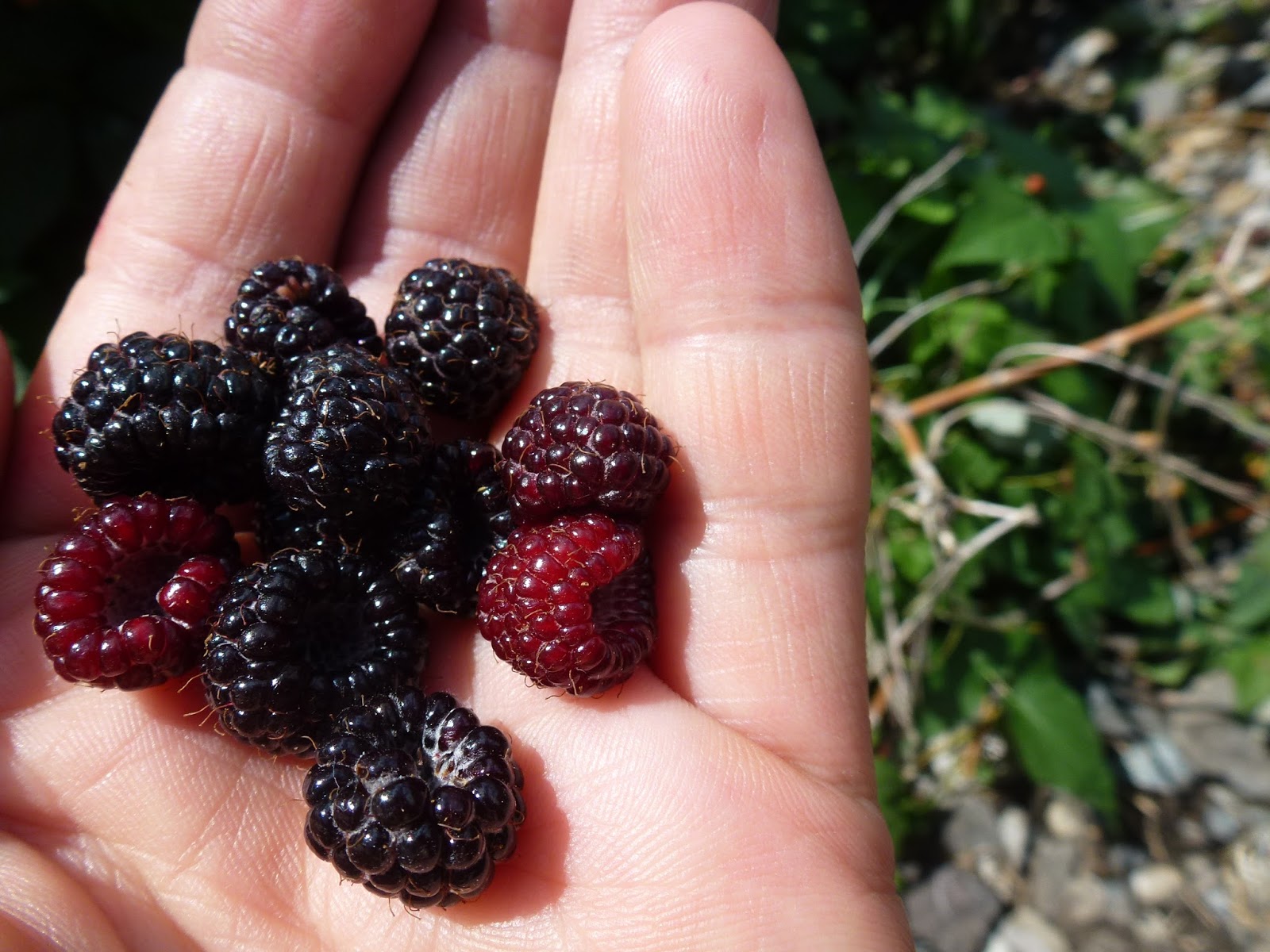
Move over goji and acai berry!  We have wild black raspberries here, and they are free, abundant, and packed with nutrition.  By now it's mid July, and it's proving to be a very bountiful berry harvest this year!  Currently, the black raspberries are in full production, growing wild along many ditches, park trails and roadways.  They line our back fenceline in huge bushes - a wild weedy patch, yet abundant in fruit.  We have have the pleasure of going out each morning for the past week to harvest huge bowls of berries for breakfast, with more than enough to stock up the freezer as well. 

Tips for harvesting:
Black raspberry (Rubus occidentalis) is related to the red raspberry (Rubus ideus), is native to North America and grows wild in many locations, including urban areas like parks, trails, river banks, ditches, and other abandoned lands.  The berries are ripe when deep dark red-black coloured, and should come off easily when plucked from the stem.  The stems and stalks are prickly with little thorns, so some careful picking is necessary in order not to get scratched.  But the slow careful picking is well worth it, as these black raspberries are amazing in luscious, rich flavour.  Here is an interesting site to tell you about the differences between red and black raspberries, as well as how to differentiate between a black raspberry and a blackberry.

Why are black raspberries a superfood?
Black raspberries (as well as blackberries and red raspberries) are extremely high in antioxidants, meaning they offer multiple health benefits including cancer-fighting properties.  The black raspberries specifically contain high levels of anthocyanins, which give them their rich, dark color. Anthocyanins work as antioxidants that help fight free radical damage in the body.  

How to use:
Eat ripe berries warm off the plant!  Feed to your kids!  Get them to help you pick.  Or freeze, dry or cook into jelly, jam, or syrup.  The black raspberry leaves can also be used for herbal tea, either hot or iced.  Steep a handful of fresh leaves (or 1-2 Tbsp dried) in 4 cups water that has just boiled for at least 10 minutes.  Sweeten with honey or maple syrup, or add fresh mint leaves to the tea blend for additional flavour.  All species of raspberry are medicinal, usually red or black raspberry is most common for women's tea (helps to regulate hormones, helps to tone uterus before labour and birthing, rich in minerals and calcium).




Wednesday, June 29, 2016

Local Superfood Spotlight: Mulberries

End of June, and the mulberries are ripe.  It seems there was a nice trend to plant mulberries and service berries in public areas around our town as edible landscaping some years ago, and we are now reaping the benefits.  There seem to be ripe mulberry or service berry trees on nearly every street, often the service berries are lining the boulevard all the way along.

Tips for harvesting:
The mulberry trees are generally easy to spot - distinctive lobed leaves, and the tell-tale signs of a blue-stained sidewalk or roadway below.   These trees can be quite tall, so picking by ladder might be in order to get the most benefit.  It's often easiest to gather the berries that have fallen to the ground, or climb the lower tree limbs and shake the branches to drop berries below onto a waiting ground sheet.

Why are mulberries a superfood?
Mulberries are one of our amazing nutrient-dense local superfoods.  They are full of antioxidants, high levels of vitamins (A, C, E, K), iron, protein and fibre, and also help boost the immune system. They have been found to regulate the blood sugar, and also help cleanse the blood and detoxify the body by stimulating the liver.  They are all around wonderful, tasty, and easily harvestable locally (for free!) if you take a bit of time to find them.

How to use:
We love freezing mulberries for winter smoothies, but also eat them fresh in our granola, or by the handful as we pick them.  They make a wonderful pie, jam and jelly as well.  Mulberries, when dried, are perfect for trailmixes or eating as a snack on the go.


Sunday, September 06, 2015

Gratitude Sunday


This week we are grateful for so many things!  Here are a few that come to mind.  What are you grateful for?

- local certified organic non-GMO sweet corn (first of the season for us!) from Organic Oasis Farm Store (it's so hard to find organic corn that this was such a treat, and we brought home dozens and dozens to put in the freezer)

- freshly harvested organic edamame (yummm) dropped off as a gift from our favourite farmer Angie at Fertile Ground CSA  (thank you Angie!)

-  fresh berries in our yard, containers filled every day, especially with loganberries (here is a link to local Whiffletree Nursery where there are numerous kinds of hardy berries, fruit and nut trees available perfect for our growing zone)

- a hummingbird that has visited our yard three nights in a row now (loving Maya's pink zinnias - she is thrilled!) - to attract hummingbirds try planting zinnias, salvia, morning glory, snapdragon, cleome, nasturtium, petunias, trumpet vine...

- bees, bees, bees on goldenrod (I have such a new appreciation for goldenrod and it's many benefits to us, and for fall forage for the pollinators)

- apples, apples, apples - we hope to press our own apple cider this year at Rolling Acres farm and cider mill (the old fashioned way)

Sunday, July 26, 2015

In the garden

In the garden right now:

~ tomatoes (had our first few, many more coming), zucchini, loads of braising greens
~ berries (raspberries, blackberries, mulberries, red and black currants, chokecherries)
~ loads of herbs (basil, oregano, dill, chives, mint, parsley, cilantro, and all the medicinal ones!)
~ peas coming to an end - letting a few pods dry on the vines so we can plant again next year
~ beans ready in a week or so
~ grapes will be in abundance very soon, just ripening
~ greens - chard, kale, spinach (almost done), lettuce greens, wild greens (nettle, dandelion)
~ just a few cukes (oh, we forgot to give them enough water this spring)