Pages

Showing posts with label elderberry. Show all posts

Sunday, December 13, 2020

Winter Herbal Remedies E-Course & Recipes!

I am excited that our first e-course will be starting in early January!  With the covid pandemic this year we (like everyone else) have had to make major changes in how we run our home business.  For many years we have been offering hands-on, in person workshops, classes and events here at Little City Farm, where groups of participants came together to learn, share and make in our small home-based teaching space.  Well, none of these types of in-person activities were possible this year, and so we have been working hard to develop a small offering of online courses instead.  Virtual learning is our preferred method - we can't meet our participants in person, it's more difficult to create a shared group experience, and the hands-on component must be done by each person in their own home without the context of being here on our homestead.  We also don't love the idea of spending more time on a screen, and certainly agree with many that we are tired of zoom videos and meetings.  However, for our first round of the e-course we think we have found a simple, uncomplicated low-tech solution, and are happy to share it with our participants.  Our first e-course filled up quickly!  It's a 12 week Winter Herbal Remedies course running from January to mid March!  We look forward to offering it again in future, as well as developing other of our most popular workshops into online offerings for the spring and summer season. 

For those who aren't able to join us with the Winter Herbal Remedies e-course for this round, we would love to offer some of our favourite herbal recipes for winter wellness that we make each season in our home.  Try the following for immune boosting, easing sore throats, healing coughs, aiding congestion and supporting best health for the winter season.  To make these recipes, if you are looking to purchase bulk dried medicinal herbs, try Harmonic Arts for an exceptional Canadian company with superior quality organic dried herbs and other wellness ingredients.


Sunday, January 27, 2013

Homemade herbal cough drops

In the fall we made our annual cough syrups to be ready for cold and flu season.  We made a batch of elderberry-ginger syrup, and the stronger version: sage-horehound-astragalus syrup.  These effective and delicious syrups are made by simmering the medicinal herbs (berries, roots and leaves) for a lengthy time, adding honey and simmering long enough to get a syrup consistency.  We have made these healing syrups for several years with good success, but had never tried cough drops.  That's just what we did today.

Cough drops are made with the same ingredients as cough syrup, but the process is slightly different.  The ingredients are simmered long enough to reach a very hot temperature (over 300F) so everything solidifies into a hard candy.  Inspired by myhealthygreenfamily, here is how we did it - the method is very simple, but you need to be careful of the hot temperatures and work quickly when the candy starts to firm up.

Elderberry-Ginger Cough Drops

Ingredients:
1 1/2 cups water
1/2 cup black cherry juice (no sugar added)
your choice herbal cold and flu tea (we used elderberry and lemon)
3 inches peeled organic ginger root
1/2 cup raw honey
powdered sugar for dipping afterward (or slippery elm powder, as suggested by a friend)

Method:
1) In a large pot bring water, juice, herbs and ginger root to a boil.  Set to simmering, and reduce from 2 cups down to 1/4 cup.  Strain the tea back into your large pot.
2) Now heat the reduced tea with the raw honey over low heat.  Do not let this boil over.  Stir constantly.  It will start to foam and bubble, and get extremely hot.
3) Stir constantly until tea-honey mixture reaches just over 300F.  Do not let this burn!  Remove from heat.
4) Pour quickly into candy molds, or onto baking sheet lined with parchment paper that is dusted with powdered sugar.
5) Once cooled, dust each candy with powdered sugar (this helps to keep them from sticking, but is really optional).  Store wrapped in parchment paper or in a glass mason jar.  Keeps one month, or longer if kept in freezer.


Monday, November 21, 2011

Winter Tonics : Elderberry Syrup

We like to prepare our herbal medicine cupboard with teas (e.g. a Winter Flu tea blend, and lots of peppermint), tinctures (e.g. astragalus, rosehip, elderberry, echinacea), and cough syrups (e.g. sage-horehound) before winter.  Recently a friend mentioned making elderberry syrup for her kids.  They loved it and it was a nice way to administer the healthful benefits of elderberries, without needing to use an alcohol base like a tincture would.  Syrups are preserved by honey or sugarand have a long shelf life.  So, we made a batch and yes, it is absolutely delicious.  It tastes sweet and rich like dense bursts of berries, and is thickened with local honey (we used buckwheat honey which made the syrup even darker).  Elderberries are one of the oldest remedies for colds, flu, respiratory infections, and many other conditions.  Elderberries are rich in antioxidants, contain 3 different flavonoids and boost the immune system.  The syrup can be taken by the teaspoonful (2-3 tsp/day as needed) or added to tea, juice, water, etc.  I like to spread it on toast or pancakes.  Isn't the best way to create vibrant health simply by "letting food be your medicine"?  Where to get elderberries?  I would highly advise planting at least one elderberry bush in your garden/yard, as this is such a valuable plant.  However, if you don't have a good local source, excellent quality organic dried elderberries can be purchased from Mountain Rose Herbs.

Elderberry Syrup
1 cup fresh or 1/2 cup dried elderberries
3 cups water
1 cup honey (or sugar) for every 1/2 cup elderberry tea

1. Place elderberries and water into saucepan and bring to a boil.  Then reduce heat, and simmer 30 minutes.  Close lid and let steep for another 30 minutes after this.  You are making a very strong tea (infusion).

2. Crush berries, then strain the liquid through a fine-meshed cheesecloth.

3. Measure your liquid, and return it to the saucepan.  Add 1 cup honey per 1/2 cup elderberry tea.  Return to heat on low, stirring occasionally, and let the liquid boil down until you have the desired consistency you want for your syrup.

4. This is a very sweet syrup and can be preserved unrefrigerated.  Use 1-3 tsp per day, as needed.  Not for children under 2 years old.  If you wish to reduce the sweetness you can store your syrup in the fridge.


Saturday, June 19, 2010

Creating great compost workshop & biodynamic compost activator plants!

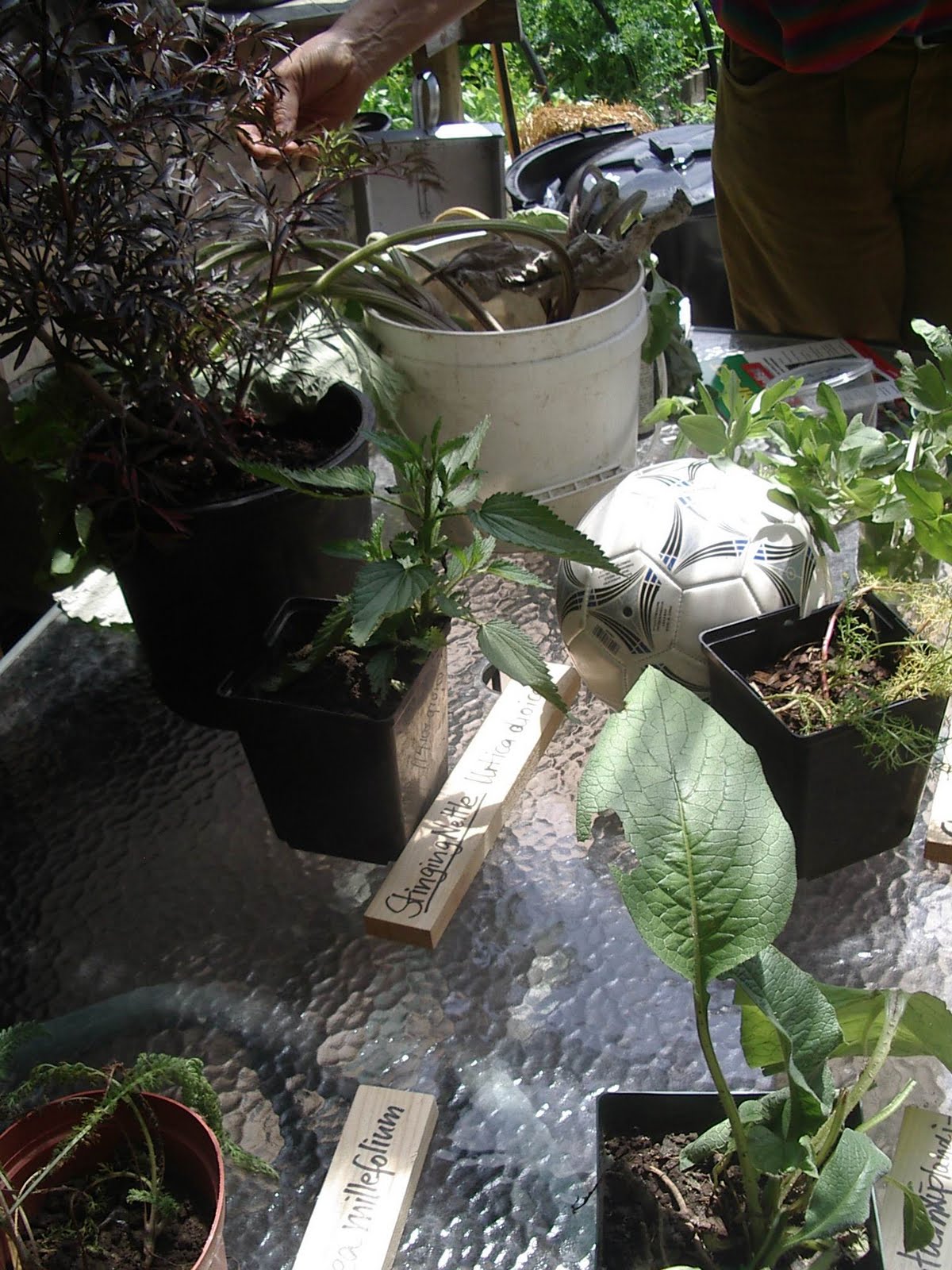
This weekend's Saturday workshop was on Compost!  Our friend Anna-Maria, long-time organic grower and CSA farmer, was here to lead the session.  She really knows her information well and although we have been composting for more than a decade and have done plenty of reading ourselves, I still came away with many new and useful ideas from her talk!  She talked about why to compost (why not?? there are just so many benefits, including fertile soil, building tilth, plant nutrient boosting, reduction of wastes going to landfills, creating closed loop systems in our own backyards, etc etc)!  She also takes a biodynamic approach to her composting, both in terms of how she layers her pile (it's like cooking for her, layering and seasoning her piles), and also in the types of plants she adds as "compost activators".  Seven useful plants recommended by Rudolf Steiner, father of biodynamic agriculture, include comfrey, yarrow, nettle, chamomile, horsetail, dandelion, and valerian.  Anna-Maria also added burdock - ideally, these are all plants you have growing in your own yard so you don't need to be dependent on outside sources.  Luckily, over the years on this property, we have encouraged all of these plants to grow here!  Even a few leaves of each, chopped up and added every few months, can do wonders for adding the proper balance to the compost pile.  Fish emulsion or seaweed can also be added...

The ideal pile would be a 30:1 ratio of carbon:nitrogen, balanced by weight not volume (she suggested if you really wanted to be precise you could leave a scale beside your compost pile!).  She talked about useful cover crops to grow, in garden beds or paths, to chop up and add to the soil or the compost pile for extra nitrogen - such as fava beans, sweet peas, clover, vetch, buckwheat, rye.  There is also a debate about whether to turn a compost pile, how often or not at all (similar to no-till gardening approaches, no-turn compost approach believes that turning disturbs the microbial life too much).  If the pile is properly layered and managed, and heats up well, then turning is not necessary - although she was clear to state that each situation is a little different, and you need to get to know your own garden, compost and conditions well to make judgements about how to manage your pile.  Anna-Maria also told us about the wonderful elderberry - which is it's own little composter as it's roots seem to create perfect compost - you can dig gently around the roots in the fall and get beautiful compost to add to your garden (not to mention eating the berries, using the flowers for wines or tincture, and more).

Now I'm off to harvest some comfrey and nettle for our compost, buy an elderberry bush, and try to plant some buckwheat and fava beans as cover crops this season!