Pages

Showing posts with label local berries. Show all posts

Saturday, July 23, 2016

Blueberry picking!

We are so fortunate to have a no-spray (nearly organic) u-pick blueberry farm nearby!  It's an annual family outing and adventure for us to go picking, usually not just on one day but many throughout the late July to August. We love to have our freezer stocked with frozen blueberries for winter smoothies and baking, as well as dried for handfuls added to trailmixes, granolas - or, our latest favourite way to preserve fruit, as fruit leather!  Here is a quick oven or dehydrator method for making blueberry fruit leather.

Blueberry Fruit Leather - easy oven or dehydrator method

You will need:
  • 1 lb fresh or frozen blueberries (or other fruit - apricots, cherries, peaches, etc)
  • 1 Tbsp lemon juice
  • 1 Tbsp honey (optional)
Method:
 
1) Preheat oven to 170F (or prepare dehydrator sheets).
2) Prepare baking sheet (or dehydrator sheet) with parchment. 
3) Place ingredients in blender and blend until smooth.  Add a little water as necessary to help blend.
4) Pour blended juice onto prepared baking sheet or dehydrator screen.
5) Spread out evening, but leave a margin around the edges of the pan/sheet.
6) Bake 6-7 hours in oven (aprox the same in dehydrator) until juice is not sticky anymore.
7) Cut into sheets or strips, roll up in the parchment paper into snack sized portions.
8) Store in glass mason jars.  Enjoy!


Sunday, July 26, 2015

Local Super Food - Chokecherries!

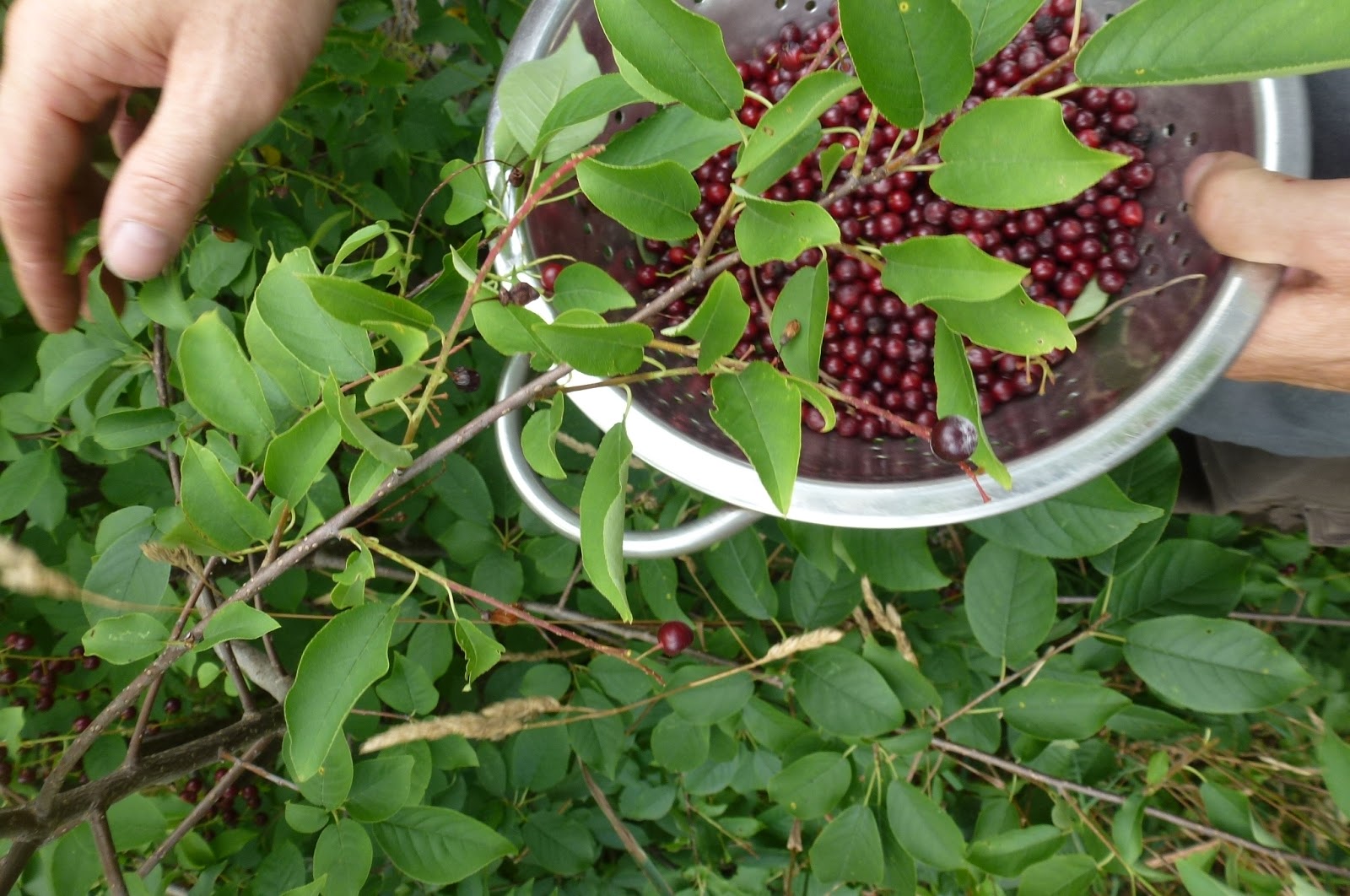
We've been noticing an exceptional berry harvest this year (other than strawberries) - the wild berries like mulberries, service berries, raspberries, and also grapes, as in greater abundance than we've seen in many years.  This was the same for the chokecherry tree in our own yard (well two, one is a volunteer that has self-seeded and is also bearing loads of fruit!).  While eating raw chokecherries should be avoided, they  do make lovely jam, wine, syrup and juice.  We are also going to try making chokecherry fruit leather this year, following this recipe idea here.  Chokecherries (Prunus virginiana) are considered some of our greatest "local super foods", along with elderberry (Sambucus nigra) as they are high in anti-oxidants and rich in vitamin C.   When using both chokecherries or elderberries the seeds need to be removed, and both of these berries need to be cooked or processed, not eaten raw.  They take a bit of work to pick, pit, and process, but oh they are worth the effort.


Monday, July 06, 2015

Gratitude Sunday


We are grateful for so many things.  Here is what comes to mind from this past week:

~ peas and more peas as we near the final harvest (and purple ones that we love to grow each year!)

~ a "cupcake and flower stand" in our front yard that our young entrepreneurial daughter decided to set up  with her friends on the weekend (and the friends and neighbours who dropped by to support our young entrepreneurs)

~ one dozen delicious Seed of Life bars that I was happy to barter in exchange for plants from our garden!  (if you have not tried these amazing high-quality handmade energy bars yet then by all means check them out!  They are now available at the Kitchener market, and various local health food stores - made locally by our friend Theresa)

~ a gifting of organic bokchoy and (my favourite) hakurai turnips from our friend Angie at Fertile Ground CSA - gorgeous produce that we just can't seem to grow here like she does on her farm!

~ a sweet baby in our house that now sleeps for more than two hours at a time!

~ the season of fresh local berries!  red currants, service berries, mulberries, raspberries and blackberries and soon to be ready cherries and blueberries

~ Tulsi (or Sacred/Holy Basil) that we grow in abundance in our herb garden, with it's many health benefits - for gifting to friends, drying for winter tea blends, and making into this refreshing Holy Basil Sipping Vinegar

What are you grateful for this week?


Friday, June 28, 2013

Berrying

What a busy time the end of June is!  Lots of garden projects, endless weeding, first herb harvests, and the start of berry season.  June is strawberry season around here; then come currants, mulberries, cherries, raspberries, blueberries all through the later summer months!  We had the first ripe strawberries from our own garden and then knew it was time for the annual early morning berry picking trip to one of our favourite local organic farms where you can pick your own: Organic Oasis.

Then on Saturday we held a sugar-free jam making (no refined sugar) workshop here at Little City Farm and made up a batch of delicious strawberry-honey jam (made with honey and apple cider as sweetener) that looks and tastes as close to fresh berries as you can get with a jam.  Regular sugar jams contain a ratio of 7 cups sugar to 5 cups fruit, and in the end all you taste is the sugar that has overpowered the true fruit and berry flavours.  You really can make perfect jams without refined sugar, using honey, agave, maple syrup, pure fruit juices, stevia or even xylitol.  The texture and colour is slightly different, but using a low sugar pectin like Pumona's the consistency and flavour is just right.  What a treat for winter that will be.  Now it's time for fresh eating, strawberry smoothies, making berry fruit leather, a strawberry pie or two, and of course putting them up in the freezer for the cold months.


Friday, February 04, 2011

Biodynamic & permaculture approaches to backyard chicken care

We love our hens...they tap on the back door each morning letting us know they are awake and ready for attention.  We've been trying to give special care during the past weeks, as the weather has been especially cold around here.  We've piled up mounds of clean straw in sunny spots in the yard where they like to hang out on warm days, and yes, we admit we even let them sneak in the house to warm up for a few minutes on occasion.  We try to bring them special food treats each day, like sprouts or carrot peelings, oats soaked in warm water, and extra grains and seeds, but it's certainly not the naturally healthful diet they get when foraging in the yard for bugs, greens and grass in the warmer months.  A friend mentioned she sprouted oats for her hens in winter, which seemed like a simple yet effective thing to do.  I am currently researching biodynamic chicken care, and in general biodynamic principles that can be applied to the small farm/urban farm and garden.  I found some useful articles about chickens here, and the site Backyard Biodynamics looks promising (but the part I really wanted to learn about was just in point form as it's the outline for a sustainable gardening course they are leading - in Australia!), as well as the Small Farm Permaculture & Sustainable Living website.  This page, Pasture Restoration of Heirloom Chickens looks really great, on the Permaculture Institute (New Mexico) site.  They offer ideas such as introducing perennial woody plantings, poultry forage and groundcovers like chicory, various brassicas (radishes, mustards), comfrey, alfalfa, vetches and clovers in the pastures where the hens roam.  The plant list for the permaculture approach to chicken pasturing also includes Nanking cherry, sand cherry, siberian pea shrub, day lilies, apples, plums, raspberries, mulberries, sea buckthorn, apricot, and comfrey.  On a small scale property at least some of these plants could be included in the layout, offering forage food for free roaming hens...ah, planning for the new season ahead.

Speaking of permaculture plants like these, a friend just loaned me her catalogue from Windmill Point Farm, an organic permaculture farm in Quebec (near Montreal) that also operates Green Barn Nursery that we've mentioned on this blog before.  They offer a staggering list of berries, fruits, nut trees and other permaculture varieties that grow hardy in our zone - incredible - and I wanted to order one of everything!  Check out this website if you are thinking of adding a forest garden or any permaculture plants to your yard.


Thursday, July 23, 2009

100-Mile Desserts: Spelt Crepes


Well it's fresh fruit season, so let's make the most of it! Today's breakfast was delectable - crepes made of organic spelt flour, covered with fresh berries, edible flowers (johnny-jump-ups, and borage) and local organic whipped cream. Hardly our usual breakfast - which tends to be organic oatmeal with homemade applesauce and local maple syrup - but we had a fridge full of beautiful berries including ones picked from our own backyard (currants, gooseberries, raspberries) so these crepes were on the menu. They would make a lovely dessert as well.

Organic Spelt Crepes - serves 4

1 cup organic spelt flour
1/2 tsp salt
3 eggs
1 1/4 cups milk

1) Mix all ingredients together in a large bowl and whisk well until lots of small bubbles form.
2) Preheat cast iron skillet and lightly coat with oil. It is helpful to oil pan before making each crepe so they don't stick.
3) Pour 2-3 Tbsp batter into the pan, and quickly rotate so batter covers entire skillet.
4) Bake 1-2 minutes for first side, then gently flip crepe and cook about 30 seconds more for second side.
5) Remove from skillet and roll up.
6) Either serve with an inside filling, or top with fresh fruit and whipped cream or yogurt.

Makes 10 medium sized crepes.