Pages

Showing posts with label wild foraging. Show all posts

Thursday, June 28, 2018

Herbal Mini-Course: Wild Herbs for First Aid


Upcoming Workshops:
Herbal Mini-Course: Wild Herbs for First Aid (Plantain / Yarrow / Comfrey) - 3 part series
Dates: Wednesdays July 11, July 18, July 25 (pre-registration required) REGISTER HERE
Time: 6:30-8 pm
Facilitator: Karin Kliewer, traditional herbalist
Location: Little City Farm

Join this short 3 part herbal mini-series to learn about 3 wild foraged first aid plants we can find in abundance all around us. In this first aid series we will cover one healing plant per session: plantain (Plantago major), yarrow (Achillea millefolium) and comfrey (Symphytum officinalis), which are all common wild plants in our city that are not easily over-harvested.

In this hands-on series we will invite you to build a relationship with these plants, by introducing their plant profiles, learning about their historical use and folklore, observing how they grow, harvesting them, and creating healing products together with these plants (with samples to take home). Each participant will also work on a personalized botanical sketch book/journal, where you can keep notes about the history and uses of these plants.

Plantain - we will make an after bug bite bath blend & nourishing plantain smoothie
Yarrow - we will make a wound oil & first aid liniment
Comfrey - we will make a healing salve

Please inform us of any allergies at time of registration. We may be using olive oil, cocoa butter, local beeswax, and certain essential oils in our classes.

More info & registration here.

Monday, May 08, 2017

Wild Dandelion Greens Pesto


Dandelion season is upon us!

One of our favourite wild plants, dandelion is readily available (growing nearly everywhere) and generally not at risk of being overharvested.  It's a great wild plant to start with if you are new to foraging for wild edibles, as all parts of it are edible (root, leaf and flower), it's highly nutritious, versatile and delicious.  The common dandelion is easy to identify.  Just make sure not to harvest in sprayed areas or near roadways so that the plants you pick are not toxic.

We love the dandelion flower blossoms in salads, baked goods (they make great additions to cookies and muffins), and dandelion drinks such as dandelion-lemonade, or dandelion blossom shrub (a mixed drink made with the blossoms first infused in organic raw apple cider vinegar).  Use only the yellow parts of the blossom, and cut away the green stems as these will impart bitter flavours (also stay away from the milky white sap in the stem - it has been traditionally used for curing warts, but is not desireable for eating).

Dandelion roots make a wonderful hot beverage.  Mix them with raw cacao nibs, cinnamon, vanilla, and your choice of milk, and you have yourself a delicious warming dandelion mocha chai.  Roots are best dug when they are young in the spring, but once the flower buds start to form leave the roots in the ground.  Roots are then also harvested in the fall, after the flowers die back.

Dandelion greens are amazing additions to smoothies, egg dishes, soups, salads (the young leaves are not quite so bitter), steamed greens, infused as medicinal tea, and - our absolute favourite for the greens - wild pesto.  We make pestos of all sorts, eating our "medicine" is always a nice way to go so that medicinal healing herbs and foods become commonplace in our kitchens and everyday table.  Any wild edible green will do for pesto (for example, we love including chickweed, dandelion greens, nettle tops, purslane, wild garlic, wood sorrel).  As well, culinary herbs such as garden sorrel, basils, mints, fennel, oregano, parsley, chives, garlic greens and scapes, and other leafy greens such as spinach or kale.  Feel free to substitute according to your taste and what is seasonally available, using this basic recipe below:

Wild Greens Dandelion Pesto

Ingredients:
2 cups sunflower seeds or hemp seeds (or nuts if you prefer)
1/4 cup olive oil (or more to taste)
2 tsp sea salt
1 large handful dandelion greens, freshly picked (or other wild green edibles)
1 large handful sorrel leaves, freshly picked (or add 1 Tbsp lemon juice in it's place)
fresh oregano, chives and parsley - a few sprigs each
2 cloves garlic
1/4 cup nutritional yeast
water as needed (to get the consistency you like for your pesto)

Method:
1) Place all ingredients into a food processor and blend well.
2) Add more olive oil or water to get a smooth consistency.
3) Add more salt, to taste.
4) Serve with wholegrain or glutenfree crackers, mixed into grain dishes, blended into pasta, as a dip for fresh veggies, or in a grilled cheese sandwich.  Pesto is so versatile!

Friday, July 15, 2016

Local Superfood Spotlight: Black Raspberries

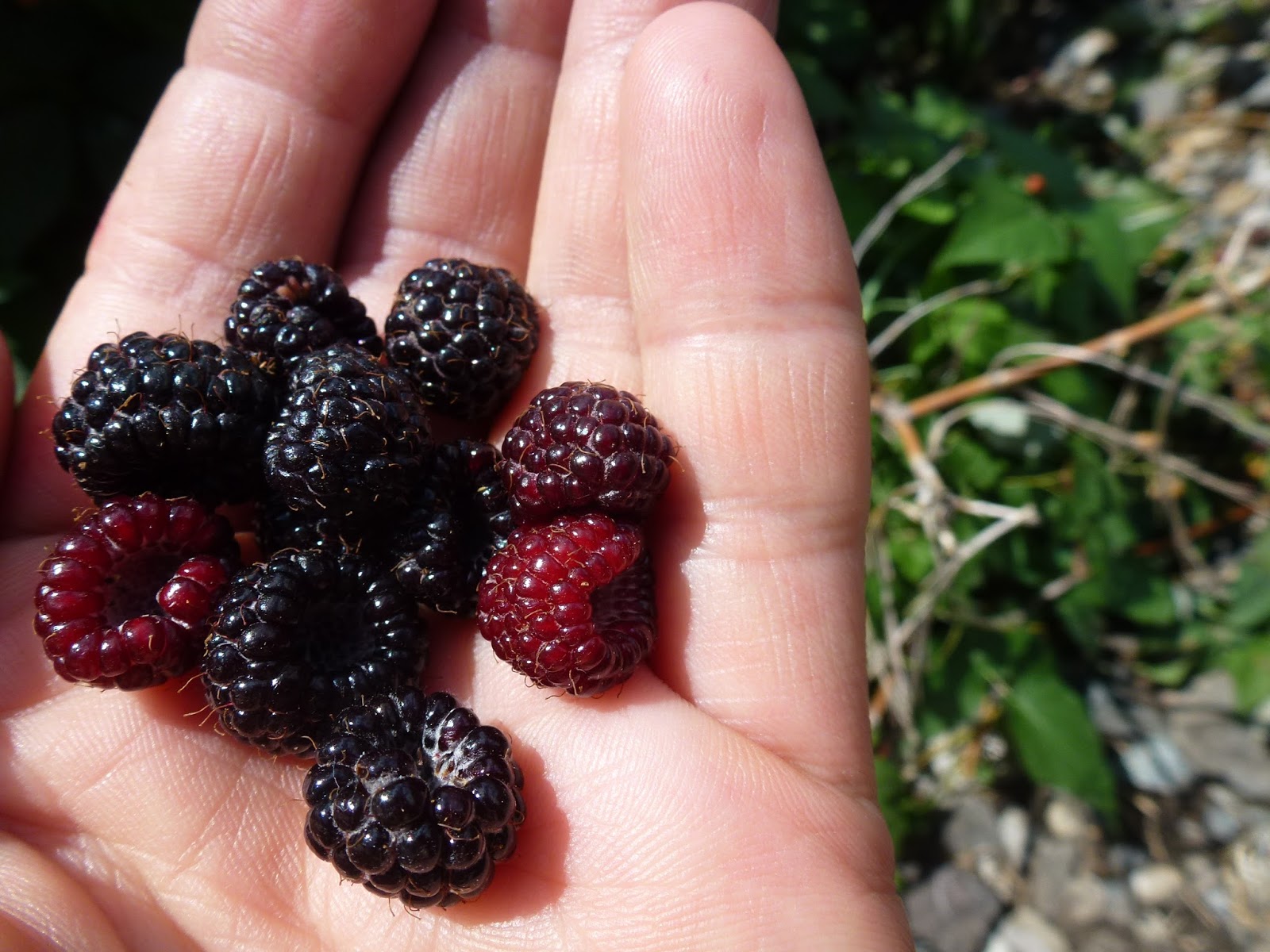
Move over goji and acai berry!  We have wild black raspberries here, and they are free, abundant, and packed with nutrition.  By now it's mid July, and it's proving to be a very bountiful berry harvest this year!  Currently, the black raspberries are in full production, growing wild along many ditches, park trails and roadways.  They line our back fenceline in huge bushes - a wild weedy patch, yet abundant in fruit.  We have have the pleasure of going out each morning for the past week to harvest huge bowls of berries for breakfast, with more than enough to stock up the freezer as well. 

Tips for harvesting:
Black raspberry (Rubus occidentalis) is related to the red raspberry (Rubus ideus), is native to North America and grows wild in many locations, including urban areas like parks, trails, river banks, ditches, and other abandoned lands.  The berries are ripe when deep dark red-black coloured, and should come off easily when plucked from the stem.  The stems and stalks are prickly with little thorns, so some careful picking is necessary in order not to get scratched.  But the slow careful picking is well worth it, as these black raspberries are amazing in luscious, rich flavour.  Here is an interesting site to tell you about the differences between red and black raspberries, as well as how to differentiate between a black raspberry and a blackberry.

Why are black raspberries a superfood?
Black raspberries (as well as blackberries and red raspberries) are extremely high in antioxidants, meaning they offer multiple health benefits including cancer-fighting properties.  The black raspberries specifically contain high levels of anthocyanins, which give them their rich, dark color. Anthocyanins work as antioxidants that help fight free radical damage in the body.  

How to use:
Eat ripe berries warm off the plant!  Feed to your kids!  Get them to help you pick.  Or freeze, dry or cook into jelly, jam, or syrup.  The black raspberry leaves can also be used for herbal tea, either hot or iced.  Steep a handful of fresh leaves (or 1-2 Tbsp dried) in 4 cups water that has just boiled for at least 10 minutes.  Sweeten with honey or maple syrup, or add fresh mint leaves to the tea blend for additional flavour.  All species of raspberry are medicinal, usually red or black raspberry is most common for women's tea (helps to regulate hormones, helps to tone uterus before labour and birthing, rich in minerals and calcium).


Wednesday, June 29, 2016

Local Superfood Spotlight: Mulberries

End of June, and the mulberries are ripe.  It seems there was a nice trend to plant mulberries and service berries in public areas around our town as edible landscaping some years ago, and we are now reaping the benefits.  There seem to be ripe mulberry or service berry trees on nearly every street, often the service berries are lining the boulevard all the way along.

Tips for harvesting:
The mulberry trees are generally easy to spot - distinctive lobed leaves, and the tell-tale signs of a blue-stained sidewalk or roadway below.   These trees can be quite tall, so picking by ladder might be in order to get the most benefit.  It's often easiest to gather the berries that have fallen to the ground, or climb the lower tree limbs and shake the branches to drop berries below onto a waiting ground sheet.

Why are mulberries a superfood?
Mulberries are one of our amazing nutrient-dense local superfoods.  They are full of antioxidants, high levels of vitamins (A, C, E, K), iron, protein and fibre, and also help boost the immune system. They have been found to regulate the blood sugar, and also help cleanse the blood and detoxify the body by stimulating the liver.  They are all around wonderful, tasty, and easily harvestable locally (for free!) if you take a bit of time to find them.

How to use:
We love freezing mulberries for winter smoothies, but also eat them fresh in our granola, or by the handful as we pick them.  They make a wonderful pie, jam and jelly as well.  Mulberries, when dried, are perfect for trailmixes or eating as a snack on the go.


Saturday, June 25, 2016

Practical Herbalist series - session 1

The first of this season's 4-part Practical Herbalist workshop series brought 14 eager participants to us today.  Over the course of 4 months (June-Sept) we are meeting one Saturday morning per month as a group. 

The goals are to provide hands-on practical experience in herbal medicine making, including harvesting and using leaves, berries, flowers, roots, bark, seeds (each as they come into their prime in the Little City Farm garden); wild-harvesting plants with the emphasis on local nutrient-dense "superfood" wild plants to be used as both food and medicine; and also helping each participant to develop a deeper relationship to medicinal plants while learning in the simpler tradition (i.e. building a relationship with plants that is hands-on, locally focused, creating simple remedies made by hand together). 

There is "homework" to be done each month between get-togethers, so that participants have the chance to practice what was talked about during the session; and also herb journals/or herbariums to work on - we will be covering 22 locally available plants so the hope is that each participant will have a good working knowledge of how to best prepare these plants for use, and how to use safely and effectively in their home for first aid and general minor ailments. 

It's a lot to pack into four short sessions, but with the month time between each workshop the participants can work as extensively as they are interested or able, to further their knowledge as we go along.  My role is facilitator and guide, helping as they develop their own personal path for herbalism.  I feel very fortunate to have the opportunity to work with such a wonderful and interesting group of participants in this way over the summer.

Today we worked with peppermint, lemon balm, nettle, red raspberry leaf, and plantain (Plantago major)- harvesting and processing these plants to make a plantain solar-infused oil; and a solar-infused sun tea (equal parts nettle, red rasp leaf, peppermint and lemon balm).  We also made a delicious nutrient-dense green smoothie with plantain, mint and lemon balm.  I especially love using locally wild-harvested herbs as food, (i.e. free "food as medicine").  Plantain is high in B vitamins, protein, Vit C and Vit K, and fatty acids.

Plantain Nutrient-Dense Green Smoothie
(adapted from a recipe by Rosemary Gladstar)

You will need:
2 cups pineapple or pear juice, organic and/or fresh
1 large handfuls of fresh plantain leaves *
small handful fresh peppermint leaves (a few sprigs)
small handful fresh lemon balm leaves (a few sprigs)
1 banana
3-4 icecubes
water to adjust consistency

* fresh plantain can be interchanged with other fresh nutrient-rich herbs like red clover, or red raspberry leaf

Method:
1) Blend everything in a blender until smooth.  Stir to mix in the foam which will form on top (delicious!).
2) Drink iced, immediately.
3) Very refreshing on a hot day!
4) Serves 6-8 people.


Sunday, June 05, 2016

Wild Plant Medicine Workshop 1 - focus on Nettle

I absolutely love nettle.  I think it's one of my favourite "wild" medicinals, with such a versatile range of applications and uses.   And since it is at it's peak right now, we offered our first workshop in the "wild plant medicine (in the city)" series on the topic of Nettle! 

Not only is it delicious, packed with nutrition (iron, calcium, vit A and C, 25% protein by weight), but healing to many aspects of our body (men, women, children, elders alike).  It is an alterative, working to bring our body back into healthy balance, meeting us where we need.  It helps stimulate all systems of elimination in the body, this removing toxins and wastes and realigning our bodies toward healthy wholeness.  It is helpful for allergies, arthritis, rheumatism, recovering from illness, beneficial for nursing mothers, and generally toning to both the male and female reproductive systems.  It does not have counter-indications with other herbs/medicines, and can be used freely and safely.  Primarily the leaves are used, harvested before they start to flower.  It can be tinctured, dried for tea or used fresh for tea and cooking (the drying, steaming or cooking removes the sting from the leaves).  See a few of our favourite nettle recipes below - taking our "medicine" as food is always a great way to go!

Nettle has a long history of co-habitation with humans.  Wherever old human settlements are in the northern boreal regions of the globe (Europe, Asia, North America) likely you will find nettle.  It is said that nettle has often been found growing over old burial grounds, bringing to mind that this special plant is protecting sacred ground - it's stinging properties mean that humans will not easily trample through a nettle patch.

Nettle is also beneficial for many species of animals - several kinds of butterfly larva only eat nettle, and also nettle is a useful food source for ground birds, reptiles and rodents in riparian areas.

So, don't think of this wonderful wild plant as just a "weed" - bring some nettle into your life, ethically harvesting* where it is growing along streams and shady moist riverbanks and wooded areas, or even planting a small patch in a contained area of your back woods/garden (be warned, nettle spreads rapidly by underground roots and rhizomes so do keep it contained by trenching the area or planting in a container).  Remember, it's called "stinging nettle" for a good reason - harvest with caution, wearing long sleeves, pants and gloves as it can cause severe contact dermatitis (red stinging itching welts) from the formic acid it releases into exposed skin through it's stinging hairs. 

* ethical wild harvesting - meaning to harvest carefully and respectfully, leaving no trace that you have been harvesting a wild plant (take no more than 1/4 of a patch, do not harvest entire plants, cover soil back to leave ground undisturbed, and leave healthy plants to go to seed and grow in the coming years)
* and when harvesting in the wild, be sure to know FOR SURE that you have properly identified the plant (use a good ID book with clear photos or sketches of plants in various times of season, or go with an experiences wild harvester who knows how to safely harvest and identify - there are some look-alike plants that can be toxic)

Here is an delicious example where nettle makes a creamy soup in place of any dark leafy green (spinach, chard, kale).  It was paired with sorrel in this lemony green soup above.


And in our workshop we made a nettle-based "medicinal" pesto - deep green, garlic-y, and delicious!

Nettle-Walnut Pesto (cheesy version)

8 cups nettle leaves (top 6 inches, removed from stalk)
2 cups other wild green edibles (we used dandelion and plantain leaves, but you could use traditional pesto garden herbs like basil or parlsey)
1 cup nuts (e.g. walnuts, pine nuts, brazil nuts, almonds)
1 cup seeds (e.g. sunflower, pumpkin, hemp)
2 cups olive oil (more or less, to get consistency you want)
1 cup parmesan, grated
1/2 cup Asiago, grated
10 clove of garlic
3 tsp sea salt

Nettle-Seed Pesto (vegan version)

8 cups nettle leaves
2 cups other wild green edibles
2 cups seeds (e.g. pumpkin, sunflower, hemp or combination of these - add in nuts if you like in place of seeds)
1 cup nutritional yeast
1-2 cups olive oil (to get consistency you want)
10 cloves garlic
3 tsp sea salt

Method:
1) Blend greens with seeds and some oil in small batches in a food processor.
2) Then add cheese/nutritional yeast, garlic and sea salt and blend well.
3) Add more olive oil if necessary to get the consistency you want.  Do not thin with water as it will create a paste, not a thick pesto sauce.
4) Taste, adjust flavours - remember the pesto will mellow and blend flavours as it sits.
5) Scoop into jars and store in fridge (for about 2 weeks) or freezer for longer term.
6) Serve with crackers, zucchini chips, as a dip for fresh veggies, mixed into pasta, on bread, mixed into mayo for a delicious veggie burger experience, and so many other great uses for pesto! 

Coming up next month in the "wild plant medicine (in the city)" series: 
Plantain - and making healing oils, salves, and bug lotions with plantain

Sunday, September 06, 2015

Gratitude Sunday


This week we are grateful for so many things!  Here are a few that come to mind.  What are you grateful for?

- local certified organic non-GMO sweet corn (first of the season for us!) from Organic Oasis Farm Store (it's so hard to find organic corn that this was such a treat, and we brought home dozens and dozens to put in the freezer)

- freshly harvested organic edamame (yummm) dropped off as a gift from our favourite farmer Angie at Fertile Ground CSA  (thank you Angie!)

-  fresh berries in our yard, containers filled every day, especially with loganberries (here is a link to local Whiffletree Nursery where there are numerous kinds of hardy berries, fruit and nut trees available perfect for our growing zone)

- a hummingbird that has visited our yard three nights in a row now (loving Maya's pink zinnias - she is thrilled!) - to attract hummingbirds try planting zinnias, salvia, morning glory, snapdragon, cleome, nasturtium, petunias, trumpet vine...

- bees, bees, bees on goldenrod (I have such a new appreciation for goldenrod and it's many benefits to us, and for fall forage for the pollinators)

- apples, apples, apples - we hope to press our own apple cider this year at Rolling Acres farm and cider mill (the old fashioned way)

Wednesday, August 12, 2015

best applesauce (from foraged fruit)!

Apple season is upon us, the early apples at any rate.  Our old tree out back is FULL, just absolutely full this year with lovely little apples.  They are not pretty by store standards, but they are our free apples, a generous harvest that we gratefully accept each year from this old tree!  The apples taste tart with a slightly sweet tinge if you pick one that is perfectly ripe, but the squirrels seem to know and knock the apples down a day or two before they really are ready to be picked by us humans.  So, I've been gathering the apples from the ground, which really is so much easier than trying to climb up into that huge old tree.  These are just right for applesauce, a ritual we have around here starting every August and continuing on well into October, with any apples we can get our hands onto.  I love to imagine the members of the  who first planted this apple tree, also picking and making applesauce to keep their household well-stocked over the winter.  We love this applesauce on our pancakes, with yogurt and granola in the morning, or simply as a healthy snack.

How we make our applesauce with our gathered/foraged fruit - the simple method:

You need:
apples
water
large pot and lid
chopping knife
cutting board
dash of cinnamon, cloves, ginger, pinch of nutmeg, cardamom, vanilla (optional, or try each one)

Method:
1) Core and chop apples, and cut away any parts that you think are overly ripe or blemished.
2) Place apple chunks (with peel on -this adds texture and colour to the sauce) into pot with a bit of water to cover the bottom.
3) Heat on medium with lid on to help steam the apples to soften them.  Stir occasionally.  Add more water so there is enough liquid that apples don't stick to bottom of the pot.
4) Add cinnamon, ginger, cloves, nutmeg, cardamom, or vanilla - optional, based on your taste.
5) When apples are softened you can leave the sauce chunky, or puree it in a food mill or food processor.
6) Ladle into glass mason jars leaving 1/2 inch space at top (minimum) and store in fridge or freezer.  This sauce can also be canned in hot water bath according to proper canning procedures.


Sunday, July 26, 2015

Local Super Food - Chokecherries!

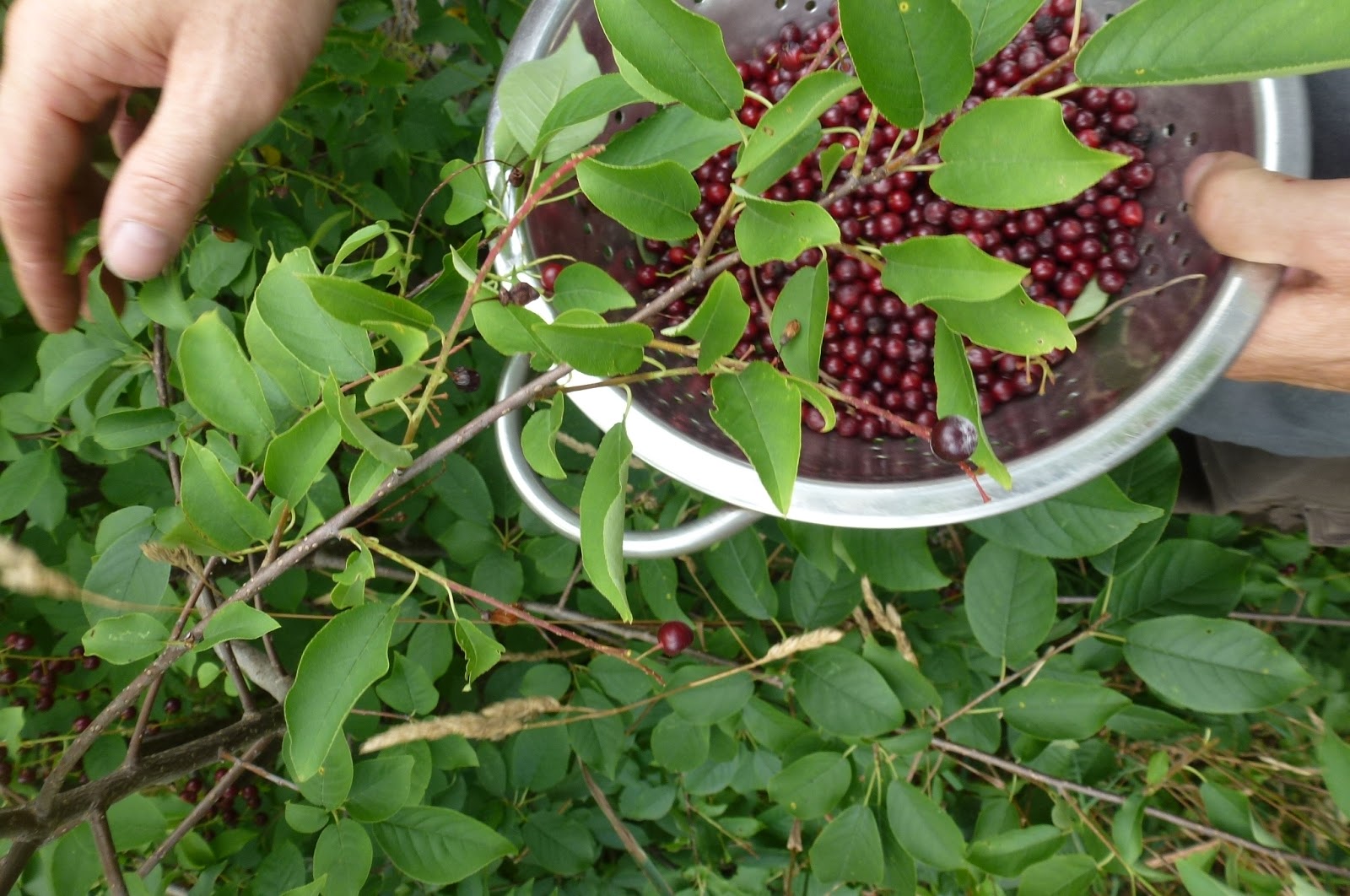
We've been noticing an exceptional berry harvest this year (other than strawberries) - the wild berries like mulberries, service berries, raspberries, and also grapes, as in greater abundance than we've seen in many years.  This was the same for the chokecherry tree in our own yard (well two, one is a volunteer that has self-seeded and is also bearing loads of fruit!).  While eating raw chokecherries should be avoided, they  do make lovely jam, wine, syrup and juice.  We are also going to try making chokecherry fruit leather this year, following this recipe idea here.  Chokecherries (Prunus virginiana) are considered some of our greatest "local super foods", along with elderberry (Sambucus nigra) as they are high in anti-oxidants and rich in vitamin C.   When using both chokecherries or elderberries the seeds need to be removed, and both of these berries need to be cooked or processed, not eaten raw.  They take a bit of work to pick, pit, and process, but oh they are worth the effort.


Sunday, May 24, 2015

Spring wild edibles are all around you!

Last weekend we had a second installment of our Spring Wild Edibles Foraging class here.  Holding this several weeks after the first session (on the same topic) was really interesting as we could see a vast change in the plants available, the new growth that has sprung up rapidly from all the warm sun we've been having.  What were just hints of leaves and buds a few weeks ago, were now fully formed flowers, leaves and perfectly sized young roots for harvesting.  Some wild spring plants we discussed in the class, such as fiddleheads and ramps (wild garlic), were already past their prime by now as they really only have a tiny window of the ideal harvesting time.  Fiddleheads literally become inedible when they are too big as they move into becoming ferns, and can make us quite sick. 

So, in this workshop it was stressed by our facilitator that it's not only having excellent plant identification skills (and remembering there are many look-alikes to be aware of), but also knowing how and when the timing is right to harvest, how much to harvest (and what not to harvest at all, tempting as it can be, because it's at risk of being over harvested - like wild ginger and ramps in some of our woodlands).  Then of course it's important to know how to prepare the wild plant.  For example, can it be eaten fresh or does it need to be cooked in several changes of water?  What parts can be eaten (roots, leaves, buds, flowers, bark, shoots)?   Can it be fermented or dried to be preserved for later? 

Plants that are edible and all around us right now - in this spring workshop we enjoyed nettles (leaves - in tea or cooked into sauces, steamed), dandelion (flowers in salads and baking, leaves in salads, roots in tea or stir-fried), dock (roots in stir-fry), cedar tips, pine tips and spruce buds (now will be past their prime, but can be made into drinks and brews, or nibbled cautiously), wild grape (leaves to be eaten as stuffed grape leaves, tendrils to be eaten fresh, and soon grapes to be eaten or made into jelly), wood sorrel (leaves that taste like lemon added into salad), purslane (leaves into salads), wild strawberries, violets, lamb's quarters,  red clover....

Please get yourself a great foraging book to ID plants before getting started - the Newcombe's Guide, or Peteron's Guide, or Lone Pine Guides, are all great plant identification resources -- or best of all, start by foraging with another knowledgeable person to learn side-by-side before you venture out on your own.

For those interested in this topic - we'll be having a Fall Wild Edibles class here at Little City Farm on Sept 19.  More details on our website - please sign up and come to join us!

Happy foraging!


Friday, April 11, 2014

Black Walnut Syrup!

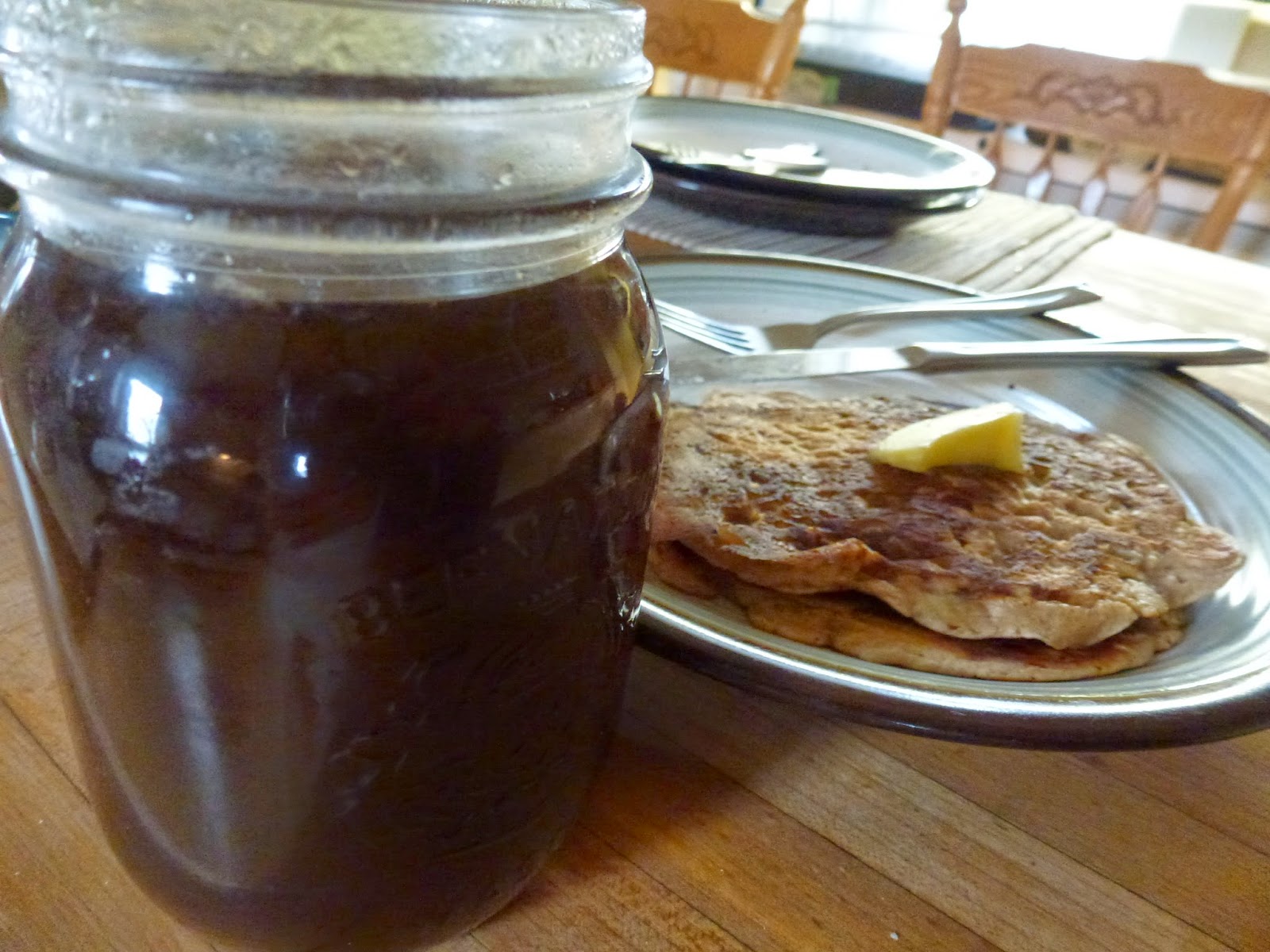
On our small urban farm we've been busy collecting black walnut sap.  After about 2 weeks of collecting sap (from 10 spiles), and 20 hours of boiling it down, from a collection of about 120 litres of sap down to 4 litres of delicious, ultra sweet black walnut syrup - and our first pancake breakfast with fresh homemade syrup - we think that's not too bad, and definitely worth the effort! 

When a friend asked how to know when the sap is syrup (so as not to keep boiling too long and get taffy or maple sugar!) we found that it becomes fairly obvious - the bubbles become brown and foaming, and it's important to watch that the pot doesn't boil over.  We tried to capture a photo of this in the 3rd photo down below.  For the first 15-18 hours of boiling there was still a lot of water evaporating so if possible this is a good stage to do outdoors (or with good ventilation or kitchen range hood fan going).  For the last hour or so it goes much more quickly.  With lots of stirring needed at this point so the near-syrup doesn't burn on the bottom of the pot, and a candy thermometre handy to read the temperature, the sap has become syrup when it reaches 219F.  At that point, pour into hot sterilized (clean) mason jars, scrape out the pot and lick the spoons!  Then start a batch of pancakes.  Yumm!  We keep a good stockpile of syrup in our fridge and store the rest for longer storage in mason jars in the freezer.  This keeps well for many months. 


Friday, September 06, 2013

Wild apple bounty

The past few days have seen baskets and bins of apples piling up on our counters.  The wild apple harvest is on, and this year is proving to be an bountiful one.  We've taken to carrying extra bags with us everywhere we go, just in case we need to do some spontaneous foraging.  We, as a family, have gathered fruit from at least 10 different types of apple trees in various locations around town, all which are walkable or bikeable from our place.  There is such abundance hidden in the city, and I love sharing this experience with our daughter.  We often meet others who are also wild foraging, including a group yesterday who was picking wild apples for their annual cider-making event. 

I just love the different colours, textures and tastes - the red and white striped markings on the apples held in the hand below is especially pretty.  Our own big old apple tree is in it's fullest year yet.  Most of these apples we use for sauce, since they do have blemishes and are not long-keeping varieties - and occasionally there is a pie.  Mmmmmm, pie.   That makes today an exceptional day.