Thursday, May 18, 2017
Mother-daughter herbal immersion
Our weeks have so far included:
Chamomile (making chamomile-infused honey, and chamomile sun tea)
Marshmallow (making marshmallow root pastilles, and tasting "real" marshmallows)
Violets (making flower fairy salad, and candied violets)
Calendula (making calendula lipbalm, and eating calendula muffins)
Dandelion (making dandelion pesto, and tasting dandelion cookies, and root mocha)
Chickweed (making chickweed super soothing salve, and chickweed super smoothie)
Chickweed Super Soothing Salve
1 cup olive oil infused with chickweed*
1/4 cup organic beeswax
5 drops lavender essential oil per 2 oz tin
Method:
Warm olive oil and beeswax in small saucepan until was has melted.
Take off heat, add essential oil and mix well. Pour into tins, let cool. Label.
Keeps about 1 year.
For soothing itching, dry skin and skin rashes, minor cuts and scrapes.
Yields: aprox. 10 oz salve
* To make the infused chickweed oil:
a) solar method - fill a 1 litre jar with fresh chickweed, and top up with olive oil to about 1 inch above the herbs. Let infuse in a bright sunny window for at least 4 weeks, shaking every few days. Top up with more oil as needed, so herbs always stay submerged. When it has steeped, strain out herbs and reserve the oil.
b) double boiler method - add a large handful of chickweed to a small saucepan, cover with olive oil so herbs are covered by about 1 inch. Warm in a double boiler on low (i.e. have another pot of water below this saucepan), for about 2 hours (do not let the herbs heat too much, the oil should not be cooking the herbs). Oil should be a deeper colour, and smell herby (not smell fried). Strain, and use in recipe above.
Thursday, May 11, 2017
Women's Herbal Retreat June 17 at Little City Farm - Registration OPEN!
Announcing!
WOMEN'S HERBAL RETREAT AT LITTLE CITY FARM - SAT JUNE 17.
Relax in a supportive small group learning environment. Reconnect to the earth through relationship to healing plant allies. Find inspiration through beauty, celebration & hands-on herbal remedy making during this retreat.
This one day retreat includes four hands-on workshops by local herbalists and holistic health practitioners. Learn to make flower essences, how to add wild nutrient-dense foods into our meals, herbal-kitchen alchemy, and making healing remedies for summer skincare.
Also, we will be nourished throughout the retreat day with wholesome delicious teas, snacks & lunch foods inspired by herbal and wild foraged fare, time for journal writing and plant herbarium creation, sketching, and photography, and participate in a plant & food swap to end our day together.
Workshop facilitators:
- Heather Cain - Flower Essences & Plant Spirit Healing
- Jackie McMillan - How to Dress a Wild Salad
- Jassie Bhuee - Herbal Kitchen Alchemy
- Karin Kliewer - Healing Summer Skincare Remedies
Food catered by Seed of Life Foods and Little City Farm (including vegan and gluten-free, organic nutrient-dense foods).
More details to follow once you have registered.
Limited to 15 wonderful participants!
Cost: $152.55 (includes HST, lunch, snacks, recipes, hand-out notes, take-home samples from workshops, and more surprises!)
Payment required to reserve your spot.
Contact Karin at info@littlecityfarm.ca for any questions.
OR Register here online.
Saturday, December 03, 2016
Outdoor baking day to celebrate the first days of winter
Come check out our wood-fired oven on Sat Dec 10 during our Little Bird Told Me handmade holiday sale. The fire will be lit so you can warm yourself after browsing our wonderful vendors.
Wednesday, January 07, 2015
Thyme-honey infusion & cough syrup for sore throats and winter coughs
THYME-HONEY-LEMON INFUSION
Yields: 1 cup infusion
1 cup water
1 tsp fresh thyme (fresh tastes much better in a tea than dried)
1 slice lemon, or 1 tsp organic lemon juice
1 tsp raw honey, or to taste (or agave, or maple syrup as you prefer)
1) Bring water to a boil.
2) Pour over thyme in a mug or bodum and let steep 5-10 minutes (or longer for stronger infusion).
3) Add slice of lemon/lemon juice, and honey to sweeten.
4) Enjoy sipping your hot tea and letting it soothe your throat!
Do not drink thyme infusion if you are pregnant.
THYME-HONEY COUGH SYRUP
Yields: approx. 3 cups syrup
2 cups water
3 Tbsp thyme (fresh) or 1 Tbsp dried
1 cup raw honey
1) Heat water in a mid-sized pot, add fresh or dried thyme thyme and steep for 10 minutes after water has boiled.
2) After thyme infusion has cooled, strain out the herbs. Then add 1 cup raw honey and whisk to combine until all honey is completely melted.
3) Store in glass jars with tight lid in fridge, which will keep for about 2 months.
To use: Use 1 tsp at first sign of cough or sore throat. Do not use if pregnant.
Monday, January 05, 2015
Easiest Gluten-free Vegan Granola Bars with Options!
Here's a new simple granola bar recipe that even our 6 year old daughter can make (with only a tiny bit of help)! They store well, pack a good amount of protein, and are delicious.
Easiest Gluten-Free Vegan Granola Bars with variations
Basic Ingredients:
1 1/2 cups whole oats (gluten free if you want a gluten-free bar)
1 1/2 cups brown rice crisp cereal (or use ground nuts for slightly different texture)
1/2 cup dried fruit (we love sour cherries, or cranberries)
1 cup total dried seeds or nuts of choice (we love pumpkin, sunflower, sesame seeds, or walnuts)
1/4 cup unhulled hemp seeds
1/4 cup coconut (unsweetened, shredded)
2 Tbsp chia seeds
1/2 tsp cinnamon
1/2 tsp ginger
1/4 tsp sea salt
1/2 cup liquid sweetener (maple syrup or brown rice syrup, or honey if not vegan)
1/4 cup almond butter (or tahini, or peanut butter)
1 Tbsp flax or hemp oil
1/2 cup dark chocolate chips (at least 70%) or cacao nibs
Instructions:
1) Combine all dry ingredients, other than chocolate chips/cacao nibs. Mix well in medium sized bowl.
2) Melt the liquid sweetener and the almond butter (or nut butter you are using) in medium saucepan over low heat, just stirring to combine.
3) Mix wet into dry and blend well.
4) Now add flax oil/hemp oil, and chocolate chips/cacao nibs. Mix well to combine, using your hands if necessary.
5) Press firmly and evenly into 8x8 inch pan that is lined with parchment paper.
6) Let chill for 20 minutes, then slice into bars. Makes 24 bars.
7) Wrap individually or store in sealed container. Keep well in freezer for several months, although you will enjoy these bars long before that!
Our favourite variations:
Pumpkin seed & cranberry
Sour cherry & chocolate chip
Coconut-lemon (add one tsp lemon oil)
Hemp seed & cacao nibs, with extra flaked sea salt sprinkled on top of bars
Friday, December 19, 2014
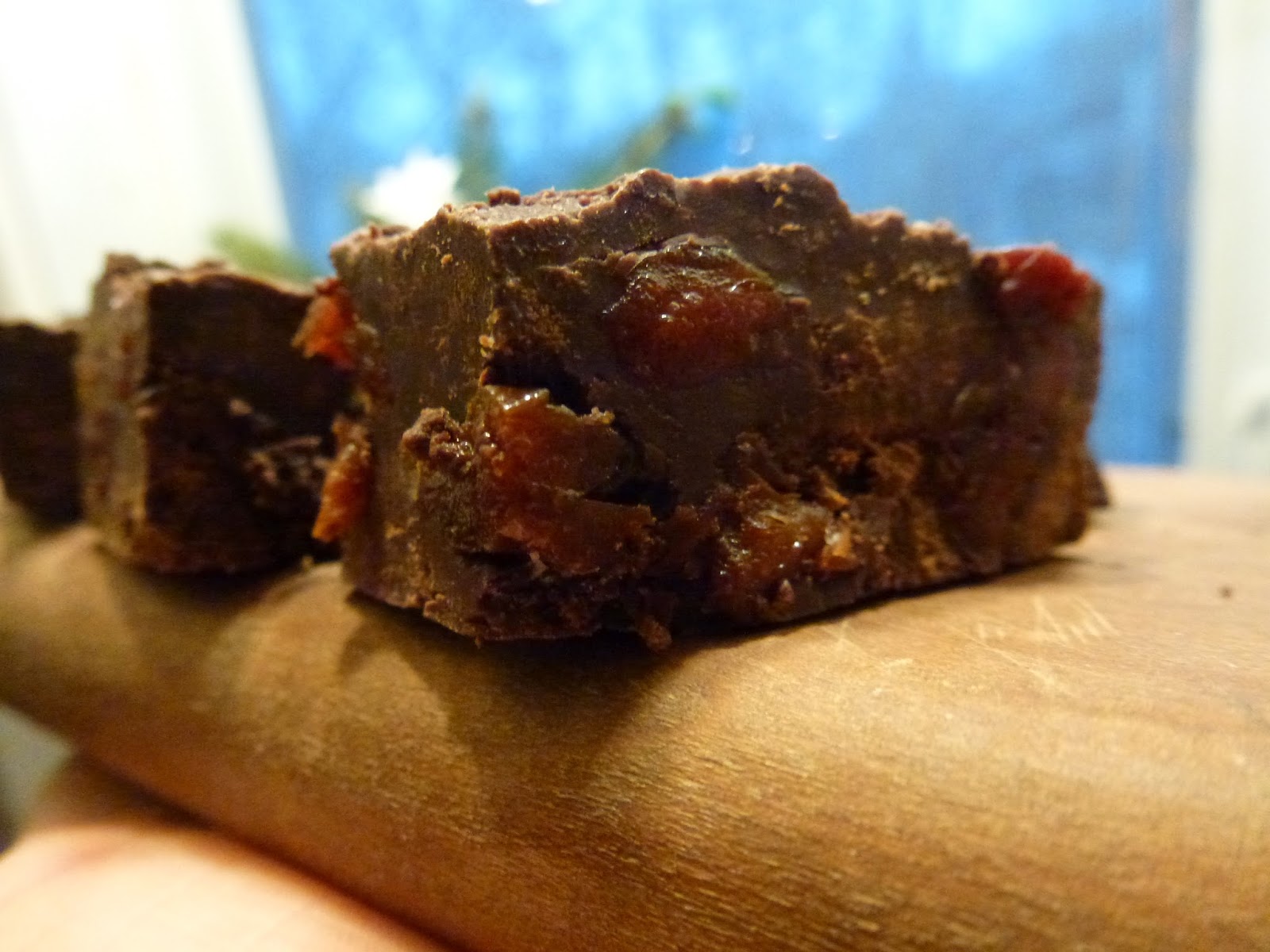
Easiest Chocolate Vegan Fudge
Here is our recipe:
Ingredients:
2/3 cup organic coconut milk (full fat)
12 oz dark chocolate chips (we like 70% minimum)
1 tsp pure vanilla (optional)
1/4 cup chopped dried fruit (sour cherries, dried blueberries) or nuts/seeds
1) Warm the coconut milk over low, and stir in the dark chocolate chips. Stir constantly until chocolate is melted.
2) Take off heat, then stir in vanilla.
3) Add 1/4 cup chopped dried fruit (sour cherries, dried blueberries, cranberries) or other seeds/nuts.
4) Pour into 8x8 pan lined with parchment paper. Let firm up in fridge. Then cut into small squares. Enjoy!
Thursday, November 06, 2014
Holiday baking begins! Gluten-free gingerbread cut-out cookies
This gingerbread is so delicious - it is very likely the BEST gingerbread cookie recipe I have ever tasted. The dough does get sticky, so chilling it is very important. They advise rolling the dough between two sheets of parchment paper, and I don't think you could roll it out any other way without a lot of sticking. Also the cookies definitely needed to be cooled before removing from the pan, as they were a little breakable when warm. It was a fun project do with my 6 year old daughter, who loved helping mix the dough (especially shaking in ALL the spices we added). We made a 4 x batch so it was a huge amount of cookies, many to give away to friends, and some of which my daughter hopes to sell at her own little booth during our Handmade Holiday sale on Nov 29. Making them gluten-free and vegan should assure that almost everyone in the room can eat them. The icing (still to come) is a cashew butter-coconut oil based mix, which pipes well out of an icing bag after it has chilled. So not only do these cookies taste amazing, they were beautiful to roll out and cut into shapes (we used "woodland themed" cookie cutters - fir trees, gnomes, stars, reindeer, owl), but they are nutritious and healthful too.
Sunday, November 11, 2012
Healthy desserts - fruit kanten
Our top combinations include apple cider with cherries; pear juice with blueberries; raspberry juice with peach slices...
Saturday, October 22, 2011
Successful Kombucha!
Once we have the starter we can keep brewing, sort of the way you keep a small portion of live culture yogurt or sourdough from each batch to start the following batch. We used a wonderful favourite wild blueberry rooibos (called the "Manitoba Blend", a gift from this tea shop in Winnipeg) blended with black tea - here is our method:
Making Kombucha
1 litre water
1/4 cup sugar
1 Tbsp loose black tea
other herbal blend to flavour (if desired - e.g. blueberry, lemon, ginger, etc)
1/2 cup mature acidic kombucha from last batch
Make tea, steep with sugar for 15 minutes. Strain, let cool, the pour into large wide-mouth clean glass jar. Add mature kombucha (save a portion of each batch for the next starter). Place mother in the liquid with firm side up. Cover with fine meshed cheese cloth or cotton muslin cloth, let sit in warm room for 7-10 days. Taste to see when your preferred acidic flavour is ready. Then store in refrigerator.
Friday, June 24, 2011
Herbal sunscreen - make-it-yourself recipe!
Herbal Sunscreen - safe for kids (use externally only, and reapply every few hours)
70 grams organic sesame oil
45 grams organic cocoa butter
15 grams pure beeswax
110 grams (4 oz) strong green tea
2 Tbsp zinc oxide
1 tsp vitamin C powder (or other natural preservative)
10-20 drops pure lavender essential oil
1) Melt sesame oil, cocoa butter and beeswax in double boiler or in a small saucepan on the stove over low heat.
2) Remove and add green tea, zinc oxide, vitamin C powder and lavender oil. Mix well with a stick blender until creamy.
3) Store in glass jars or other small containers with tight fitting lids (or reuse an old sunscreen tube). Keep in cool location to keep in thick spreadable condition (or firm sunscreen back up if necessary by placing in the fridge for half an hour).
Tuesday, December 14, 2010
Creating a healthy home - looking for alternatives to plastic!
A friend recently dropped off a book she insisted I should read. She had initially taken it out from the library, but was so drawn in that she needed to purchase a copy for herself before she was even done reading it. I'm sure many of you have come across this title and subject already - I had seen the book Slow Death by Rubber Duck: How the toxic chemistry of everyday life affects our health - but I had not yet picked it up to read it. I generally felt that our family is quite aware of keeping toxins and chemicals out of our household, and this book would not reveal much new information. However, reading just the first chapter made me re-evaluate this thought, as I started to go over a list in my mind of all the subtle ways toxins creep into even the most eco-minded lifestyle. First of all plastics (toothpaste tubes, rice milk cartons, tofu and tempeh wrapped in plastic, almost any packaging on newly purchased items, shampoo bottles, children's toys, winter snow suits, shower curtains)...then chemicals (furniture, virtually any new clothing, carpets, car interiors, plush toys). It has been said that in an average day in North America we are exposed to over 450 toxins, just by eating 3 meals and going back and forth to work. Of course, all these toxins all build up over time in our bodies to cause a myriad of health problems.
So, how to limit the exposure, especially in our homes? It seems like you need to start with a serious purge in our homes of many familiar items, and then constant vigilence - difficult to do, and certainly not everyone has the budget to purchase all organic or so-called "eco" home products. However, by minimizing the prevalence of plastics and toxins in our home we can actually save money, because one easy way to do this is by buying less (especially new items), reusing things or purchasing second hand, and making things ourselves with natural materials.
Here are a few simple ideas on how to reduce the amount of plastics coming into the home.
a) milks, yogurts - buy in glass jars
b) freezer bags - freeze food in glass jars, or can/preserve it in glass jars to avoid longterm freezer storage
c) produce bags - avoid those flimsy plastic produce bags at the grocery store by bringing your own cotton reusable produce bags
d) shower curtains - use natural materials like cotton, or hemp which is naturally anti-microbial
e) toothpaste tubes - a simple and effective toothpaste can be mixed in a glass jar using baking soda and a few drops of pepppermint essential oil or tea tree oil
f) dish and laundry detergents - purchase in bulk and store in glass jars
g) cleaning agents - use baking soda, lemon, and vinegar for effective (and cheap) cleaning
h) bread bags - store bread in old fashioned bread boxes, paper bags, or ceramic containers with lids
i) tupperware, ziploc bags and plastic food wrap - use cloth bags, glass jars, ceramic dishes to store food
j) diapers and disposable wipes - use cloth diapers made of wool, cotton or hemp, and reusable cloth wipes and natural sprays
k) tea and coffee packaging - use loose-leaf tea, or your own garden variety, and purchase coffee in bulk and store in glass jar
l) dishes and glasses - purge your cupboard of any plastics and scour thrift stores for glass cups, ceramic, stainless steel, and wooden dishes/bowls
m) bedding - if you can spend the money, do it here - we average about 1/3 of our lives sleeping, so healthful bedding is important! use natural materials in bedding, mattresses, blankets like cotton, natural fibres, wool filling
n) clothing - try for all natural materials, or at least non-new clothing items (to avoid exposure to chemicals that treat new clothing)
o) house paints - by now there are lots of non-toxic, non VOC paints at every paint store, and at reasonable prices so these are an obvious choice
p) kid's toys - go for used, or non-toxic, all natural toys (wood, cloth, wool)
q) shampoos - make your own, use shampoo soap bars, or apple cider vinegar rinses rather than plastic bottles
r) food - to minimize plastic packaging when buying food, try to purchase in bulk (bulk flours, beans and grains usually come in brown paper bags), whole foods (e.g. produce at the market or grocery store, CSA, or home-grown), or in glass containers that are refillable (e.g. nut butters, honey, syrup, apple cider, milk, yogurt)
Tuesday, November 09, 2010
Winter health elixirs
1) Miso soup - this is our vegetarian version of good old homemade "chicken soup" - we make our miso soup with a strong broth of fresh ginger, garlic and cayenne peppers, plus apple cider vinegar, tamari, some kale, carrots, onion and tofu, and then the miso paste stirred in at the last minute (you generally don't want to boil miso or the health benefits are largely lost)
2) Fresh juices - made with organic carrots, ginger, garlic, parsley (and orange or lemon if you have it)
3) Hot lemon ginger tea - boiled with water on the stovetop, and honey or maple syrup added to sweeten
4) Tinctures - taken 3 tsp/day for acute situations - rosehip, astragalus, horehound, echinacea (all prepared in the fall and stocked in the cupboard for winter care)
5) Sage cough syrup and horehound cough candy - see recipe in my earlier post - this syrup and cough candy may not taste divine, but it works wonders to ease coughs and colds
6) Eucalyptus oil and peppermint oil in a hot bath - great for easing congestion
7) Sage steam - to ease congestion (pour boiling water into large stainless steel bowl, cover head with a towel and lean over to inhale the steam and heat as long as you can stand it - this works well for clearing a stuffy nose)
Many more great suggestions in Rosemary Gladstar's The Family Herbal: A Guide to Living Life with Energy, Health and Vitality. Currently this amazing resource book is unfortunately out of print, but try looking for it at your local library or health food store.
Thursday, January 14, 2010
Winter Kimchi


I mentioned earlier that I've started another live cultered sauerkraut. It's actually not quite a sauerkraut as it's not just cabbage - it's more of a winter kimchi - a spicy, garlicy, health-tonic made of pickled vegetables. Kimchi can be made in a variety of styles and originates in Korea where it is a national culinary art and passion.
This recipe is loosely based on the one found in Wild Fermentation: The Flavour, Nutrition and Craft of Live-Culture Foods by Sandor Ellix Katz, a fantastic cookbook and cultured food history. This cookbook is always close at hand in our kitchen, as we are trying to work our way through all manner of fermented foods and this wide ranging book covers everything from vegetable ferments (like sauerkraut and pickles); bean ferments (like miso and tempeh); bread ferments (like sourdough and dosas); dairy ferments (like yogurt and savoury cheeses); plus fermented grains, beverages, wines, vinegars and more!
This kimchi is extremely simple to make - the secret is just the right amount of spicing to suit your taste and then allowing enough time to ferment. The recipe is extremely adaptable, just use what vegetables you like or have at hand. Here is an aproximation of what I used:
Winter Kimchi
fresh garlic (3 whole bulbs)
onion (2 large)
ginger (1/2 inch sliced)
dried cayenne peppers (3 large including seeds)
carrots (3 large)
green cabbage (3 heads)
daikon radish (6 inches)
filtered water (14-18 cups)
sea salt (14-18 Tbsp)
First the vegetables are shredded or chopped to a desireable size, then stirred together in a large jar or ceramic crock. The container is then filled with enough brine solution to completely cover the vegetables when weighed down with a large plate and weight - to make the very strong brine solution 1 Tbsp of sea salt added to each cup of filtered water. Then the crock is covered with a clean cloth, and set on the counter to ferment. It can be tasted each day, and any mould is skimmed off. When it achieves desired taste the kimchi can be packed into jars, covered with brine, and refrigerated. True wild lacto-bacilli ferments are never canned or pasteurized, as this kills off the vital healthy bacteria. It can keep almost indefinitely in the fridge, but will likely be eaten in short order! Wild ferments like this are invaluable for building immunity and a healthy digestive system, and should be a regular part of everyone's daily meal routine. Delicious!
Sunday, January 10, 2010
Caring for Winter Colds & Flu Naturally...


So far this season we've been fortunate to have avoided major cold or flu outbreaks in this house. Since the fall we've been taking daily doses of herbal tinctures like echinacea and rosehip to build our immune system, as well as multivitamins and acidophilus (to maintain healthy intestinal bacteria). We eat a diet that is strongly influenced by macrobiotic principles, using whole grains like brown rice, millet and quinoa, tempeh, steamed seasonal vegetables, lots of kale and brassicas, sprouted and fermented foods, pro-biotic yogurt, winter squash, hearty stews, apples or other fruit which we've dried or frozen from the summer months. We try to limit processed foods and refined sugars in our diet as these weaken the body's system, and limit other dairy products which often lead to congestion - difficult to avoid during the holiday season laden with rich festive foods, it's no wonder so many of us come down with colds and other illnesses post-Christmas! Whenever we have a first onset of cold or flu symptoms we brew up strong infusions of ginger-lemon-cayenne tea or miso-garlic soup, and this generally seems to do the trick.
This week our kitchen became a natural health laboratory as I worked at concocting a variety of items to have on hand over the winter months. A new batch of raw cabbage sauerkraut, a super food we should all be consuming every day as it's an excellent source of vitamin C, lactobacilli, and other nutrients that help aid digestion and maintain overall health, and is well known as an immune booster that helps fight colds and other infections. (For anyone looking to learn more about the vast health benefits and how-to of creating fermented foods at home, consider attending our Fermented Foods workshop in April.)
Other herbal remedies completed this week include Astragalus root tincture which is renowed for building the immune system and building bronchial strength (finally ready to strain and bottle this week, after steeping for 12 weeks since October); bath therapy salts that use pure epsom salts, sea salts and essential oils to help with congestion, aches and chills; sage cough syrup made with local honey and garden sage; and a strong herbal "winter flu fighter" blend that incorporate a selection of flu fighting herbs harvested and dried from our garden this summer (including purple and green sage, thyme, rosemary, horehound, fennel, hops and more).
Some of these new winter herbal products will also be listed on our etsy store later this week.
www.homesteadherbal.etsy.com
Friday, January 09, 2009
Healthy Home Cleaning Recipes
Happy New Year! The start of a new year is always a great time to do a thorough house cleaning, especially in our case where we've been under constant renovation for the past six months. We just finished our new bathroom (in the strawbale portion of the house), and part of this was installing a vintage full size clawfoot tub. Thanks to our friends Liz and Dave for this gift. It had been sitting in their garden for years waiting for a good home.
This tub was in great condition, but needed a little help on the rust stains. I did some research into non-toxic cleaners and came up with four good solutions:
1) Shampoo (let sit for several hours, then scrub with finest steel wool)
2) Silky Scrub: 1 cup baking soda, 1/2 cup liquid castille soap, 5-10 drops antibacterial essential oil such as lavender, tea tree, or rosemary. Make into "frosting" consistency (from Natural Home Magazine).
3) Hot Vinegar - plug sink, pour in the hot vinegar (heated to near boiling on stove), and let sit several hours.
4) All Purpose Cleaner: 1/2 cup vinegar, 1/4 cup baking soda (or 2 tsp borax), poured into 2 litres (1/2 gallon) water. Good for water deposit stains, bathroom chrome fixtures, windows, bathroom mirrors, and more (from www.eartheasy.com).
The following is an extensive list of natural non-toxic home cleaners! The recipes look very simple, using ingredients you already have around the house. This information comes from www.eartheasy.com.
Today's modern home is loaded with toxic and polluting substances designed to make domestic life easier.
The cost of these commercial, chemical-based products can be high -- long term health concerns for the family, and environmental pollution caused by their manufacture and disposal. In the US, for example, 1 in 3 people suffer from allergies, asthma, sinusitis or bronchitis (US National Center for Health Statistics). Treatment for these conditions should include reducing synthetic chemicals in the home environment.
For many home-cleaning chores, you can make your own cleaning products using the formulas listed below.
A growing number of commercial non-toxic home cleaning products are also available, as healthier and environmentally responsible alternatives. Your use of these products helps promote the growth of green businesses which are contributing to a sustainable economy.
Homemade Substitutions
There are many inexpensive, easy-to-use natural alternatives which can safely be used in place of commercial household products. Here is a list of common, environmentally safe products which can be used alone or in combination for a wealth of household applications.
- Baking Soda - cleans, deodorizes, softens water, scours.
- Soap - unscented soap in liquid form, flakes, powders or bars is biodegradable and will clean just about anything. Avoid using soaps which contain petroleum distillates.
- Lemon - one of the strongest food-acids, effective against most household bacteria.
- Borax - (sodium borate) cleans, deodorizes, disinfects, softens water, cleans wallpaper, painted walls and floors.
- White Vinegar - cuts grease, removes mildew, odors, some stains and wax build-up.
- Washing Soda - or SAL Soda is sodium carbonate decahydrate, a mineral. Washing soda cuts grease, removes stains, softens water, cleans wall, tiles, sinks and tubs. Use care, as washing soda can irritate mucous membranes. Do not use on aluminum.
- Isopropyl Alcohol - is an excellent disinfectant. (It has been suggested to replace this with ethanol or 100 proof alcohol in solution with water. There is some indication that isopropyl alcohol buildup contributes to illness in the body. See http://drclark.ch/g)
- Cornstarch - can be used to clean windows, polish furniture, shampoo carpets and rugs.
- Citrus Solvent - cleans paint brushes, oil and grease, some stains. (Citrus solvent may cause skin, lung or eye irritations for people with multiple chemical sensitivities.)
- Trisodium phosphate (TSP) - a mixture of soda ash and phosphoric acid. TSP is toxic if swallowed, but it can be used on many jobs, such as cleaning drains or removing old paint, that would normally require much more caustic and poisonous chemicals, and it does not create any fumes.
Formulas
Combinations of the above basic products can provide less harmful substitutions for many commercial home products. In most cases, they're also less expensive. Here are some formulas for safe, alternative home care products:
Note: These formulas and substitutions are offered to help minimize the use of toxic substances in your home, and reduce the environmental harm caused by the manufacture, use and disposal of toxics. Results may vary and cannot be guaranteed to be 100% safe and effective. Before applying any cleaning formulations, test in small hidden areas if possible. Always use caution with any new product in your home. Make sure to keep all home-made formulas well-labeled, and out of the reach of children.
All-Purpose Cleaner: Mix 1/2 cup vinegar and 1/4 cup baking soda (or 2 teaspoons borax) into 1/2 gallon (2 liters) water. Store and keep. Use for removal of water deposit stains on shower stall panels, bathroom chrome fixtures, windows, bathroom mirrors, etc.
Another alternative is microfiber cloths which lift off dirt, grease and dust without the need for cleaning chemicals, because they are formulated to penetrate and trap dirt. There are a number of different brands. A good quality cloth can last for several years.
Air Freshener: Commercial air fresheners mask smells and coat nasal passages to diminish the sense of smell.
• Baking soda or vinegar with lemon juice in small dishes absorbs odors around the house.
• Having houseplants helps reduce odors in the home.
• Prevent cooking odors by simmering vinegar (1 tbsp in 1 cup water) on the stove while cooking. To get such smells as fish and onion off utensils and cutting boards, wipe them with vinegar and wash in soapy water.
• Keep fresh coffee grounds on the counter.
• Grind up a slice of lemon in the garbage disposal.
• Simmer water and cinnamon or other spices on stove.
• Place bowls of fragrant dried herbs and flowers in room.
Bathroom mold: Mold in bathroom tile grout is a common problem and can be a health concern. Mix one part hydrogen peroxide (3%) with two parts water in a spray bottle and spray on areas with mold. Wait at least one hour before rinsing or using shower.
Carpet stains: Mix equal parts white vinegar and water in a spray bottle. Spray directly on stain, let sit for several minutes, and clean with a brush or sponge using warm soapy water. For a heavy duty carpet cleaner, mix 1/4 cup each of salt, borax and vinegar. Rub paste into carpet and leave for a few hours. Vacuum.
Chopping block cleaner: Rub a slice of lemon across a chopping block to disinfect the surface. For tougher stains, squeeze some of the lemon juice onto the spot and let sit for 10 minutes, then wipe.
Coffee and tea stains: Stains in cups can be removed by applying vinegar to a sponge and wiping. To clean a teakettle or coffee maker, add 2 cups water and 1/4 cup vinegar; bring to a boil. Let cool, wipe with a clean cloth and rinse thoroughly with water.
Deodorize:
• Plastic food storage containers - soak overnight in warm water and baking soda
• In-sink garbage disposal units - grind up lemon or orange peel in the unit
• Carpets - sprinkle baking soda several hours before vacuuming
• Garage, basements - set a sliced onion on a plate in center of room for 12 - 24 hours
Dishwasher Soap: Mix equal parts of borax and washing soda, but increase the washing soda if your water is hard. If you want to use a commercial dishwashing soap, try Ecover Ecological or Trader Joe's powders, which contain no bleach or phosphates.
Dishwashing Soap: Commercial low-phosphate detergents are not themselves harmful, but phosphates nourish algae which use up oxygen in waterways. A detergent substitution is to use liquid soap. Add 2 or 3 tablespoons of vinegar to the warm, soapy water for tough jobs.
Disinfectant: Mix 2 teaspoons borax, 4 tablespoons vinegar and 3 cups hot water. For stronger cleaning power add 1/4 teaspoon liquid castile soap. Wipe on with dampened cloth or use non-aerosol spray bottle.
Drain Cleaner: For light drain cleaning, mix 1/2 cup salt in 4 liters water, heat (but not to a boil) and pour down the drain. For stronger cleaning, pour about 1/2 cup baking soda down the drain, then 1/2 cup vinegar. The resulting chemical reaction can break fatty acids down into soap and glycerine, allowing the clog to wash down the drain. After 15 minutes, pour in boiling water to clear residue. Caution: only use this method with metal plumbing. Plastic pipes can melt if excess boiling water is used. Also, do not use this method after trying a commercial drain opener--the vinegar can react with the drain opener to create dangerous fumes.
Fabric softener: To reduce static cling, dampen your hands, then shake out your clothes as you remove them from the drier. Line-drying clothing is another alternative.
Floor Cleaner and Polish:
wood: apply a thin coat of 1:1 vegetable oil and vinegar and rub in well.
painted wood: mix 1 teaspoon washing soda into 1 gallon (4L) hot water.
brick and stone tiles: mix 1 cup white vinegar in 1 gallon (4L) water; rinse with clear water.
Most floor surfaces can be easily cleaned using a solution of vinegar and water. For damp-mopping wood floors: mix equal amounts of white distilled vinegar and water. Add 15 drops of pure peppermint oil; shake to mix.
Furniture Polish: For varnished wood, add a few drops of lemon oil into a 1/2 cup warm water. Mix well and spray onto a soft cotton cloth. Cloth should only be slightly damp. Wipe furniture with the cloth, and finish by wiping once more using a dry soft cotton cloth.
For unvarnished wood, mix two tsps each of olive oil and lemon juice and apply a small amount to a soft cotton cloth. Wring the cloth to spread the mixture further into the material and apply to the furniture using wide strokes. This helps distribute the oil evenly.
Laundry Detergent: Mix 1 cup Ivory soap (or Fels Naptha soap), 1/2 cup washing soda and 1/2 cup borax. Use 1 tbsp for light loads; 2 tbsp for heavy loads.
Lime Deposits: You can reduce lime deposits in your teakettle by putting in 1/2 cup (125ml) white vinegar and 2 cups water, and gently boiling for a few minutes. Rinse well with fresh water while kettle is still warm.
Marks on walls and painted surfaces: Many ink spots, pencil, crayon or marker spots can be cleaned from painted surfaces using baking soda applied to a damp sponge. Rub gently, then wipe and rinse.
Metal Cleaners and Polishes:
aluminum: using a soft cloth, clean with a solution of cream of tartar and water.
brass or bronze: polish with a soft cloth dipped in lemon and baking-soda solution, or vinegar and salt solution.
chrome: polish with baby oil, vinegar, or aluminum foil shiny side out.
copper: soak a cotton rag in a pot of boiling water with 1 tablespoon salt and 1 cup white vinegar. Apply to copper while hot; let cool, then wipe clean. For tougher jobs, sprinkle baking soda or lemon juice on a soft cloth, then wipe. For copper cookware, sprinkle a lemon wedge with salt, then scrub.
gold: clean with toothpaste, or a paste of salt, vinegar, and flour.
silver: line a pan with aluminum foil and fill with water; add a teaspoon each of baking soda and salt. Bring to a boil and immerse silver. Polish with soft cloth.
stainless steel: clean with a cloth dampened with undiluted white vinegar, or olive oil. For stainless cookware, mix 4 tbs baking soda in 1 qt water, and apply using a soft cloth. Wipe dry using a clean cloth.
Mold and Mildew: Use white vinegar or lemon juice full strength. Apply with a sponge or scrubby.
Mothballs: The common mothball is made of paradichlorobenzene, which is harmful to liver and kidneys. Cedar chips in a cheesecloth square, or cedar oil in an absorbant cloth will repel moths. The cedar should be 'aromatic cedar', also referred to as juniper in some areas. Cedar chips are available at many craft supply stores, or make your own using a plane and a block of cedar from the lumberyard. Homemade moth-repelling sachets can also be made with lavender, rosemary, vetiver and rose petals. Dried lemon peels are also a natural moth deterrent - simply toss into clothes chest, or tie in cheesecloth and hang in the closet.
Oil and Grease Spots: For small spills on the garage floor, add baking soda and scrub with wet brush.
Oven Cleaner: Moisten oven surfaces with sponge and water. Use 3/4cup baking soda, 1/4cup salt and 1/4cup water to make a thick paste, and spread throughout oven interior. (avoid bare metal and any openings) Let sit overnight. Remove with spatula and wipe clean. Rub gently with fine steel wool for tough spots. Or use Arm & Hammer Oven Cleaner, declared nontoxic by Consumers Union.
Paint Brush Cleaner: Non-toxic, citrus oil based solvents are now available commercially under several brand names. Citra-Solve is one brand. This works well for cleaning brushes of oil-based paints. Paint brushes and rollers used for an on-going project can be saved overnight, or even up to a week, without cleaning at all. Simply wrap the brush or roller snugly in a plastic bag, such as a used bread or produce bag. Squeeze out air pockets and store away from light. The paint won't dry because air can't get to it. Simply unwrap the brush or roller the next day and continue with the job. Fresh paint odors can be reduced by placing a small dish of white vinegar in the room.
Rust Remover: Sprinkle a little salt on the rust, squeeze a lime over the salt until it is well soaked. Leave the mixture on for 2 - 3 hours. Use leftover rind to scrub residue.
Scouring Powder: For top of stove, refrigerator and other such surfaces that should not be scratched, use baking soda. Apply baking soda directly with a damp sponge.
Shoe Polish: Olive oil with a few drops of lemon juice can be applied to shoes with a thick cotton or terry rag. Leave for a few minutes; wipe and buff with a clean, dry rag.
Stickers on walls: Our children covered the inside of their room doors with stickers. Now they are grown, but the stickers remained. To remove, sponge vinegar over them several times, and wait 15 minutes, then rub off the stickers. This also works for price tags (stickers) on tools, etc.
Toilet Bowl Cleaner: Mix 1/4 cup baking soda and 1 cup vinegar, pour into basin and let it set for a few minutes. Scrub with brush and rinse. A mixture of borax (2 parts) and lemon juice (one part) will also work.
Tub and Tile Cleaner: For simple cleaning, rub in baking soda with a damp sponge and rinse with fresh water. For tougher jobs, wipe surfaces with vinegar first and follow with baking soda as a scouring powder. (Vinegar can break down tile grout, so use sparingly.)
Wallpaper Remover: Mix equal parts of white vinegar and hot water, apply with sponge over the old wallpaper to soften the adhesive. Open room windows or use a fan to dissipate the pungent vinegar smell.
Water Rings on Wood: Water rings on a wooden table or counter are the result of moisture that is trapped under the topcoat, but not the finish. Try applying toothpaste or mayonnaise to a damp cloth and rub into the ring. Once the ring is removed, buff the entire wood surface.
Window Cleaner: Mix 2 teaspoons of white vinegar with 1 litre (qt) warm water. Use crumpled newspaper or cotton cloth to clean. Don't clean windows if the sun is on them, or if they are warm, or streaks will show on drying. The All-Purpose Cleaner (above) also works well on windows. Be sure to follow the recipe, because using too strong a solution of vinegar will etch the glass and eventually cloud it.
Healthy Home Cleaning Habits
Exchange Air:
Many modern homes are so tight there's little new air coming in. Open the windows from time to time or run any installed exhaust fans. In cold weather, the most efficient way to exchange room air is to open the room wide - windows and doors, and let fresh air in quickly for about 5 minutes. The furnishings in the room, and the walls, act as 'heat sinks', and by exchanging air quickly, this heat is retained.
Minimize Dust:
Remove clutter which collects dust, such as old newspapers and magazines. Try to initiate a 'no-shoes-indoors' policy. If you're building or remodelling a home, consider a central vacuum system; this eliminates the fine dust which portable vacuum cleaners recirculate.
Keep Bedrooms Clean:
Most time is spent in the bedrooms. Keep pets out of these rooms, especially if they spend time outdoors.
Use Gentle Cleaning Products:
Of the various commercial home cleaning products, drain cleaners, toilet bowl cleaners and oven cleaners are the most toxic. Use the formulas described above or purchase 'green' commercial alternatives. Avoid products containing ammonia or chlorine, or petroleum-based chemicals; these contribute to respiratory irritation, headaches and other complaints.
When house cleaning, save the floor or carpet for last. Allow time for the dust to settle before vacuuming.