Pages

Monday, November 14, 2011

Roasting coffee - a do-it-yourself method

We try to grow as much as we can of what we eat; if now grow then buy locally; if not locally available then buy fair trade and organic.  Coffee falls into this latter category.  Some would not consider roasting coffee to be a vital homesteading skill, but we have found it to be quite useful (operating a bed and breakfast and having at least one person in the household who enjoys coffee every day).  There are loads of fair trade, organic and shade-grown coffee brands available at health food stores, Ten Thousand Villages, most cafes, and even some grocery chains by now, and here in town we also have a few local roasteries that provide freshly roasted coffee beans. 

However, we have the do-it-yourself mentality and are always eager to learn new skills, so we set about learning how to roast good coffee (on a shoe-string budget, i.e. without buying an expensive home roaster).  Friends who have lived in various parts of Africa showed us the best way to roast coffee in a cast iron pan over the fire, but about two years ago we came across another interesting way to roast coffee - in the hopper of an electric popcorn maker.  We promptly found a used popcorn maker at the local thrift sore, and tried it out.  So simple, with great results!  Roasting coffee sends chaff flying everywere so it's wise to do it outdoors.  Depending on the roast you want, it can take from about 5-20 minutes, until the beans are crackling, dark and oily.  The smell is delicious!   Our popcorn maker takes a maximum of 110 grams of beans, and you need to stir occasionally to even out the roast.  Then let the beans cool in a collander, and voila, incredible home-roasted coffee.  We buy our beans green through a local friend who is directly involved with farmers in Guatemala through a project called Cafe Justicia.  They also sell their coffee roasted and ground, in various places here in town.


First snowfall (a hint of it)

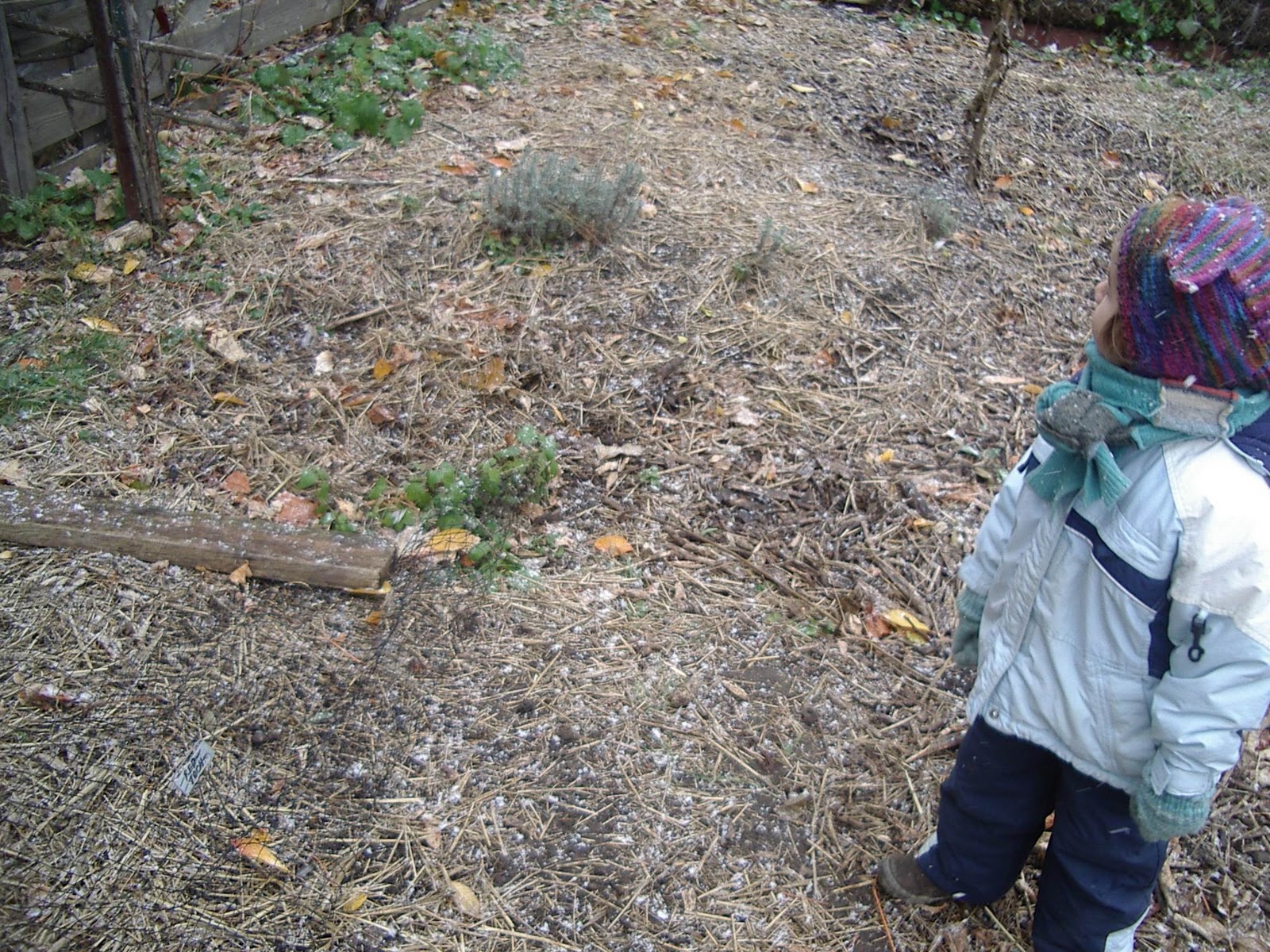
First snow...didn't last more than a few minutes as it fell to the ground, but the weather has officially taken a shift toward winter now.  The garden is now mulched with straw and leaves, only kale and carrots still making a cheerful appearance; our clothing has begun to layer, our hat and mitten basket is full again, woolen scarves hang on the coat rack, and our insulated muck boots as well as winter footwear have been brought out from storage; our bicycle shed is nearly finished, but we'll continue to cycle to our errands around town (we love our children's bike trailer from Wike in Guelph) until the deep of winter is here; winter tonics, teas and syrups have been prepared and our herbal remedies shelf is well stocked up (read more on our favourite winter health tonics from last year's post here); the sky is more often grey than blue, the grass is brown and crackling, the air is chilly with occasional warm spells that surprise us..these are the slow rumblings of winter beginning in southern Ontario.  Very different from the brilliantly sunny, heavily snowy, unpredictably stormy Manitoba prairie I grew up in.


Friday, November 11, 2011

Back to soap making

I haven't had much time for soapmaking the past few months - garden and house projects have taken priority, and then I've also been busy teaching soapmaking classes this month (with more new classes coming in January), so it is exciting to get back into making new batches myself in time for the holidays.  My eager 3 year old helper was by my side for each of these four batches yesterday, wearing her long rubber gloves, doing a little stirring, sifting herbs, measuring the essential oils for me, and choosing the nicest lavender sprigs to lay on top of the goatmilk bars.  The bars featured below: lavender-oatmeal goatmilk; peppermint poppyseed; patchouli cedar and sage; rosemary lemongrass (it's light green from the french green clay, and strong infusion of rosemary tea).  Each batch we make uses as least one herb grown in our garden. 


Tuesday, November 08, 2011

A Little Bird Told Me Craft Sale Vendor Profile: Elena Christy

Over the weeks leading upto our annual handmade holiday craft sale, "A Little Bird Told Me", on Sat, Dec 10, we are highlighting each one of the participating vendors.  Here is a short interview with Elena Christy (handmade eco-friendly accessories):

Little City Farm: Describe the products you will have at the Little Bird Sale.

Elena: Handmade accessories with a focus on using re-worked, second hand and eco-friendly fabrics and materials. Products include:
~ Chunky wool scarves and cowls
~ Jersey knit cowls
~ Laptop sleeves (ready made for mac laptops, pc laptop cases can be made to order as they all come in varying sizes)
~ Cloth napkins
~ Yoga bolsters made with green cotton (cotton that is not certified organic but has not been sprayed)

Little City Farm: How did you learn this craft/art?

Elena: I am mainly self-taught with a few one-day workshops here and there. 

Little City Farm: What inspires your craft/art?

Elena: I get great satisfaction out of making something for someone that they will love for a long time.  I also really enjoy the process of thinking through how to execute a project.  I make all my own patterns and love the creative challenge it offers.  I love turning an idea into reality and have a strong interest in aesthetically beautiful yet practically functional things. 
  
Little City Farm: Describe how your craft/art is eco-friendly?

Elena:  I try to re-work old clothes or use second hand fabric from thrift shops, or fabric people are trying to get rid of rather than buying new. When I do buy new fabric and materials I try to purchase eco-friendly fabrics and materials to make my items such as green cotton or eco-wool.

Little City Farm: Favourite music to listen to while you craft?

Elena: Right now I have been listening a lot of Mumford and Sons, Foster the People, Morning Benders, Bon Iver, Wintersleep and a little Broken Bells.

Little City Farm: Do you have a website/blog/online shop?
  
Elena: echristy.ca is coming soon…hopefully :)


In celebration of neighbourhood potlucks

There are so many disheartening stories that make it into the daily news, that is is especially encouraging when you read such a positive one as this - the celebration of community through the simple act of hosting weekly neighbourhood potlucks - read more about the Wednesday night potlucks hosted by Al and Wendy here.

Sunday, November 06, 2011

Heirloom garlic project

We are taking part in an heirloom garlic project with Seeds of Diversity, Canada's non-profit seed saving organization.  There are over 200 varieties of heirloom garlic being grown and saved across Canada as part of this project, many on small urban farms or gardens such as ours, as well as many larger farms across the country.  The idea is to grow the garlic for two years, reporting on growing conditions each year, as well as saving the garlic to send back to the Seeds of Diversity seed bank.  We chose to grow 3 soft necked varieties, as the other garlic we usually grow in our garden is hard necked Rocambole variety that has scapes we also harvest and use.  The soft necked varieties don't form scapes, but tend to be longer keepers.  We were given varieties called Applegate (a superb mild Artichoke variety of garlic), Early Silverskin (white-pink skin, great for braiding), and Red Toch (another Artichoke variety with a little more heat than the Applegate).  We had fun planting about 100 cloves were today, labelling the plots well so they don't get mixed up, and we are crossing our fingers for a good crop next summer.  Seeds of Diversity is always looking for more participating in growing their vast selection heirloom varieties of vegetables, so if you are at all eager to learn more or get involved do check out their website. 


In our November greenhouse

We are still harvesting greens (kale, chard, tatsoi, parsley, bunching onions) from the cold outdoor garden, but in our mini garden inside the greenhouse new young exciting shoots and sprouts are starting to come up.  We'll be eating from these over the winter months (some as sprouts, some as full leafy greens) -- kale, chard, mizuna, lettuces, green onions, radish, cilantro, beet greens, spinach -- and we also have pots of herbs, kale, marigolds and calendula, and a few delicious sweet and precious strawberries that are still flowering.  Outside we'll put in our grow tunnels (greenhouse grade plastic pulled over a frame that sits on the raised beds), and I have filled a raised box with soil to use as a cold frame under old winter glass. A good standby for winter or cold hardy gardening techniques is Eliot Coleman's Winter Harvest Handbook, or the Four Season Garden.


Herbal order for local midwives

We were very pleased to be asked to prepare a batch of herbal post-partum packages for a new local midwifery office - the Blue Heron Midwives located in uptown Waterloo.  This beautiful new clinic has just opened and is having their grand opening event in a few weeks: Nov 25 at 2 pm.  The midwives that gave me the tour when I dropped off the herbs (i.e. post-partum bath teas and calendula healing salves) mentioned that they are very interested in taking new clients, so this is worth noting for our local readers who may be looking for a midwife.  It's often difficult to get a midwife here in town if you don't call right away, so it's wonderful to have another office open up to provide what is obviously a much needed service.


This Moment

{This moment} - This moment - an end of week ritual, no words, just a special photo to remember, savour, enjoy. 


Wednesday, November 02, 2011

A Little Bird Told Me Craft Sale Vendor Profile: Jesse Robertson Re-Cycled Crafts

Over the weeks leading upto our annual handmade holiday craft sale, "A Little Bird Told Me", on Sat, Dec 10, we are highlighting each one of the participating vendors.  Here is a short interview Jesse Robertson, Re-Cycled Crafts:

Little City Farm: Describe the products you will have at the Little Bird Sale (e.g. materials you use, who your products are geared toward, your process, etc).
 
Jesse: I collect and recycle used bicycle components to make unique crafts. The pieces are professionally brazed, so are very sturdy. Things I’ll be displaying will include candle stands, candelabras, bottle openers, and more.  The candle stands hold tea lights or tapers, and the candelabras hold three of either. Some of the bottle openers include an integrated 15mm wrench, and all have been rigorously tested on a standard ¾ inch beer bottle cap. These re-cycled crafts are great for anyone who enjoys cycling, candle-lit dinners, one-of-a-kind conversation pieces or… well, opening bottles.

Little City Farm: How did you learn this craft/art?
Jesse: I’ve been working as a bicycle mechanic for over 5 years, and I’ve always been interested in finding potential new uses for the interesting looking bits of worn out components. The pieces are primarily brazed by a friend, and the rest has been trial and error!

Little City Farm: What inspires your craft/art?
Jesse: A love of bicycles and their parts, and re-imagining uses for things that would otherwise be thrown away.
 
Little City Farm: Describe how your craft/art is eco-friendly?
 
Jesse: The components I work with have all lived out their useful lives on bicycles, and would otherwise have been thrown away. No new components are used in the process.

Little City Farm: Favourite music to listen to while you craft? 

Jesse: Usually something by Tom Waits, but I’ve also been on a pretty serious Leatherface kick lately… or any good anarcho-punk.

Come find Jesse and his recycled bicycle artworks at A Little Bird Told Me Sale on Sat, December 10th at 508 Duke St W!


Tuesday, November 01, 2011

The great neighbourhood pumpkin patch

The first ever "great neighbourhood pumpkin patch" was held on our street tonight.  Inspired by the great  "pumpkin patches" that spring up in neighbourhoods in Toronto and Montreal (and last year uptown Waterloo), we spent a little time organizing for this same kind of event to take place in a nearby park.  The idea is simple: people bring their carved pumpkins to display in one large communal patch on the evening after Halloween, offering an opportunity to share creativity and simply give neighbours a chance to meet each other in an informal setting.  In Toronto many of the pumpkins on display have been grown in a community garden within the neighbourhood, which adds another layer of community involvement that we love.  On fairly short notice, and as a first time event, we think it was a grand success - there were nearly 50 pumpkins gathered and an estimated 75-80 adults and children mingling in the park.  We plan to do this again next year, and hope it can become an annual event that brings people from this neighbourhood together.


This Moment

{This moment} - This moment - an end of week ritual, no words, just a special photo to remember, savour, enjoy. 

Friday, October 28, 2011

A Little Bird Told Me Craft Sale Vendor Profile: Laura's Honey

Over the weeks leading upto our annual handmade holiday craft sale, "A Little Bird Told Me", on Sat, Dec 10, we are highlighting each one of the participating vendors.  Here is a short interview with Laura Stirling, 4th generation beekeeper, of Laura's Honey.

Little City Farm: Describe the products you will have at the Little Bird Sale:

Laura: I will offer gift sized jars of pure raw honey as well as beautiful sections of natural comb, presented in a small decorative container.  There will also be rolled, tapered beeswax candles as well as the "pillar" variety.

Little City Farm: How did you learn this art/craft?

Laura: I am blessed to be the fourth generation of a family of beekeepers.  My great grandfather, Hubert Burke began keeping bees as a profession in the early 1900s.  His son, Douglas Burke continued the tradition, expanding the buisness and managing a large apiary.  My father Randy Burke, began his own apiary in Manitoba and as a little girl I helped my father in his many bee yards.  It was there I learned that bees are a facinating insect, readily approachable and certianly nothing to be afraid of.  I enjoyed watching my father work, helping by smoking the bees, as well as stealing pollen from easily accessable pollen traps!  I recently decided to invest in my own hive and had a profitable first year.  Next year I hope to expand by purchasing additional hives for my bee yard.

Little City Farm: What inspires your art/craft?

Laura: My deep love of the natural world continually inspires my desire to keep bees.  It is very satisfying to open a hive and see freshly drawn out comb, filled with honey produced by the bee who harvests nectar from nearby flowers.  Not to mention pollination, which allows each of us the priviledge of enjoying fresh fruit and vegetables every year.  I love being a part of this natural process.

Little City Farm: Describe how your art/craft is eco-friendly.

Laura: The beekeeper not only harvests the honey, but also concerns themselves with the honey bee's health and well being.  I monitor the health of the brood (young) and regularly check for and if need be, treat for disease.  This promotes the continued health of the honey bee, which as I am sure some of you know, is under some strain right now due to climate change.  Beekeepers are also actively concerned about the use of new genetically modified seed, as some of these seeds are engineered to destroy insects when the fruit is ingested.  Bees consume the pollen of these plants and it is unknown whether they are able to tolerate it.  In addition to this, over the years beekeepers have been an active voice against the use of pesticides, as any pesticide will kill the honey bee. 

Little City Farm: Do you have favorite music to listen to while you work?

Laura: The sounds of the world around me while I work - wind, bees humming and birds!

Find Laura and her beautiful honey and beeswax products at the A Little Bird Told Me Sale, Saturday December 10 at Little City Farm (508 Duke St W, Kitchener). 


Enjoying the frost

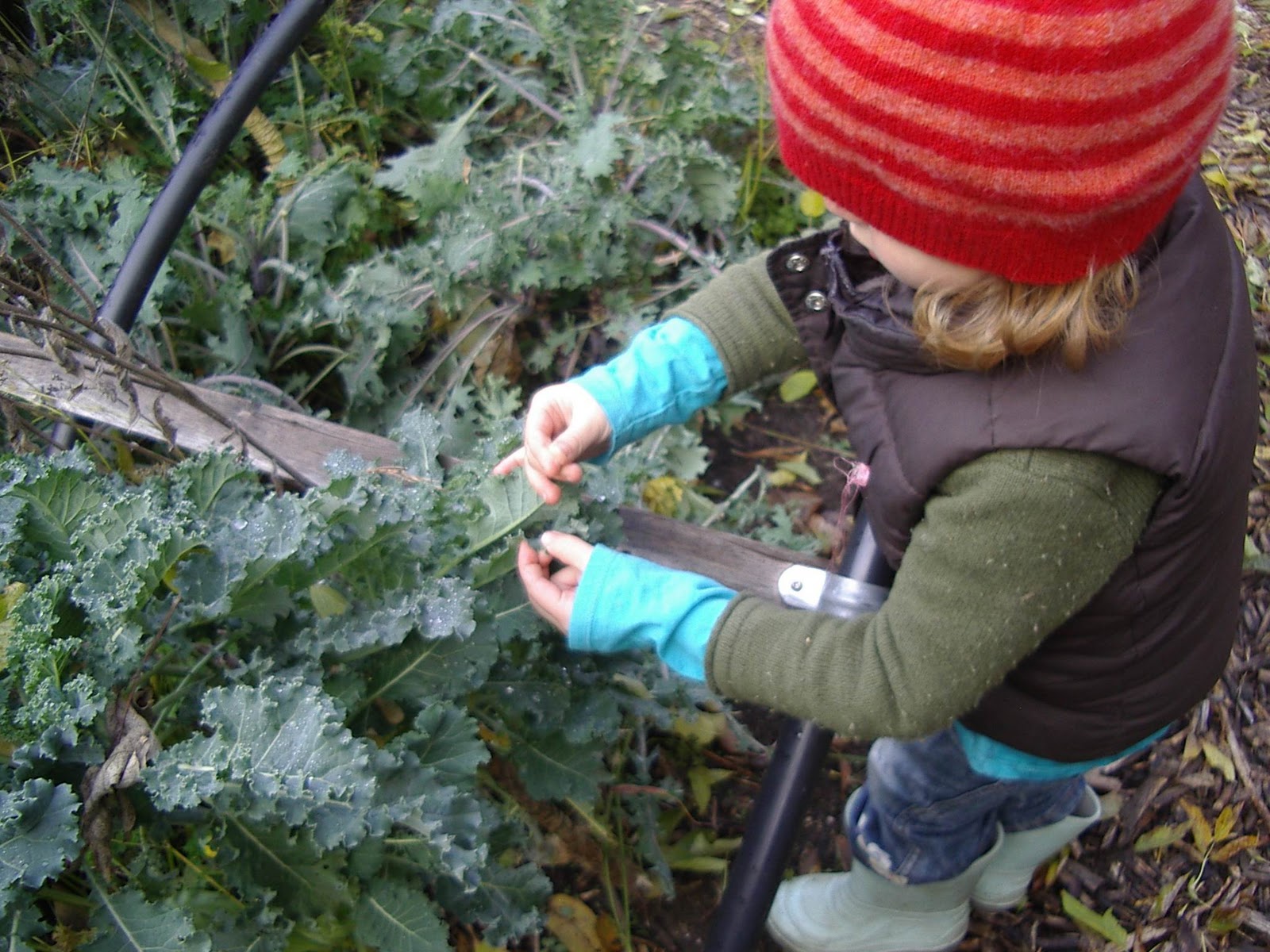
We spent the early waking moments of this morning enjoying the frost.  It's nearly November and it felt good to see the frost come - it's time for a change of season.  We've done our canning and preserving; had our last CSA vegetable pick-up day; we have pulled our zucchini, beans and tomatoes, planted garlic, put in flower bulbs for the spring; we have green tomatoes ripening on our window ledge and new fresh green shoots coming up in the greenhouse (including a few rows of french beans, which our 3 year old absolutely wanted to plant but that will likely not make it in a winter garden!); we've stacked our wood on the porch (even though a new woodshed is still in progress) and are feeling ready to enjoy the coming winter.  "What does frost taste like?" our 3 year old wanted to know, so she painstakingly picked frozen water droplets off the kale leaves and tasted them (frost tastes delicious by the way) - and this offered a great chance for a conversation about the water cycle!


Tuesday, October 25, 2011

A Little Bird Told Me Craft Sale Vendor Profile: Two Cent Sparrow

Over the weeks leading upto our annual handmade holiday craft sale, "A Little Bird Told Me", on Sat, Dec 10, we are highlighting each one of the participating vendors.  Here is a short interview with Kristen Ciccarelli from Two Cent Sparrow (ceramic jewellery):

Little City Farm: Describe the products you will have at the Little Bird Sale.

Two Cent Sparrow: I make stoneware jewellery, mainly pendants and earrings. If I could sum up my designs in two words, they would be earthy and simple. My making process is done in intervals. First I cut and shape clay by hand or throw on the wheel. Pieces are then dried, glazed, and fired to cone 6 (roughly 2300 degrees). Afterwards, the pieces are finished by attaching chord, chain, or earring backs. Last, I pair finished pieces with inspiring words and phrases. I want my work to not only be wearable, but also a source of inspiration and contemplation.

Little City Farm: How did you learn this craft/art?

Two Cent Sparrow: I took classes from a few local potters about seven years ago, saved up for my own wheel and kiln, began teaching myself, set up a studio in my basement (which has recently moved to Globe Studios), and the rest is history.

Little City Farm: What inspires your craft/art?

Two Cent Sparrow: I love being able to make something out of nothing. Clay is so malleable and anything you dream up you can do, really. As for inspiration, it might sound cliché, but I’ve always been drawn to natural spaces (the woods, bodies of water, fields) and because clay/glaze is such an earthy medium, it just kind of fits.

Little City Farm: Describe how your craft/art is eco-friendly?

Two Cent Sparrow: Making pottery is not as eco-friendly as it might seem. Firing a kiln uses a lot of energy. Ingredients in glazes and clay are mined, and some are toxic in their raw form. However, I have a very low production studio. Most of my pieces are hand built instead of thrown on an electric wheel. I have a tiny kiln (4x4x8 inches) and only fire it about half a dozen times a year. I rarely do a bisque firing, which cuts down on the total amount of firings. Because of this, I don’t use that much energy or go through materials very quickly, and there’s very little waste. Moreover, I work at home or at my studio – which is a walk-able distance from my house. My products don’t get thrown away, and if broken and disposed of, they don’t have a negative environmental impact. The fact that I’m just a little business helps me to be more eco-friendly.

Little City Farm: Favourite music to listen to while you craft?

Two Cent Sparrow: It changes over time, but right now it’s Ludovico Einauldi and Zoe Keating.

Little City Farm: Do you have a website/blog/online shop?

Two Cent Sparrow:  
Yes I do! My etsy shop is here:  
www.etsy.com/shop/kristenciccarelli 

and my blog is here: http://twocentsparrow.blogspot.com


Saturday, October 22, 2011

Successful Kombucha!

We just bottled and consumed our first successful batch of kombucha - it was our second attempt to make this delicious fermented live culture tea elixir that has a long list of reputed health benefits.  This time we got a large starter "mother" culture (i.e. a gelatinous mass of bacteria and yeast) from a helpful neighbour (thanks Mike!).  It seems that finding this "mother" is the hardest part of making kombucha.   After a week of steeping our tea with the starter culture and mother floating on top, it had turned into what we think to be just as tasty a kombucha as any we've been purchasing from the health food store.  I think we might be hooked.

Once we have the starter we can keep brewing, sort of the way you keep a small portion of live culture yogurt or sourdough from each batch to start the following batch.  We used a wonderful favourite wild blueberry rooibos (called the "Manitoba Blend", a gift from this tea shop in Winnipeg) blended with black tea - here is our method:

Making Kombucha 
1 litre water
1/4 cup sugar
1 Tbsp loose black tea
other herbal blend to flavour (if desired - e.g. blueberry, lemon, ginger, etc)
1/2 cup mature acidic kombucha from last batch

Make tea, steep with sugar for 15 minutes.  Strain, let cool, the pour into large wide-mouth clean glass jar.  Add mature kombucha (save a portion of each batch for the next starter).  Place mother in the liquid with firm side up.  Cover with fine meshed cheese cloth or cotton muslin cloth, let sit in warm room for 7-10 days.  Taste to see when your preferred acidic flavour is ready.  Then store in refrigerator.